Romeo Castellucci creates scenes and images that are pregnant with meaning, yet they never come to term. In Hey Girl! a nude girl rises from underneath a layer of melting wax or clay. She gets up and looks into a mirror. She puts on a white t-shirt and a pair of jeans. She lies down next to a sword. She spritzes perfume on the sword, which sizzles on the blade. The sword is hot. With the sword she burns a cross into a white sheet. She whispers the names Jeanne d'Arc and Maria Stuart. She picks up the sword. A bang. A neon sign in the upper right corner of the stage displays an R. The girl walks to the right. Another bang. A neon sign on the upper left side of the stage displays an L. The girl walks to the left. Right. Left. Right. The girl is pummeled with pillows by a group of some 30 men. The girl emerges with an enlarged mask of her own head. The girl cries. The men disperse. Some look at her through glass windows. Words and fragments from Shakespeare are projected on a screen. A black woman wearing a mask of the girl's enlarged head emerges from the crowd of onlooking men. An old man with a beard. The black woman is undressed and chained. The glass windows break. Music. The black woman dances. A screech. A beam of light pierces through the air and seems to cut into the girl's head. A wooden panel falls and is raised again, revealing a reproduction of Jan van Eyck's Man in a Red Turban.
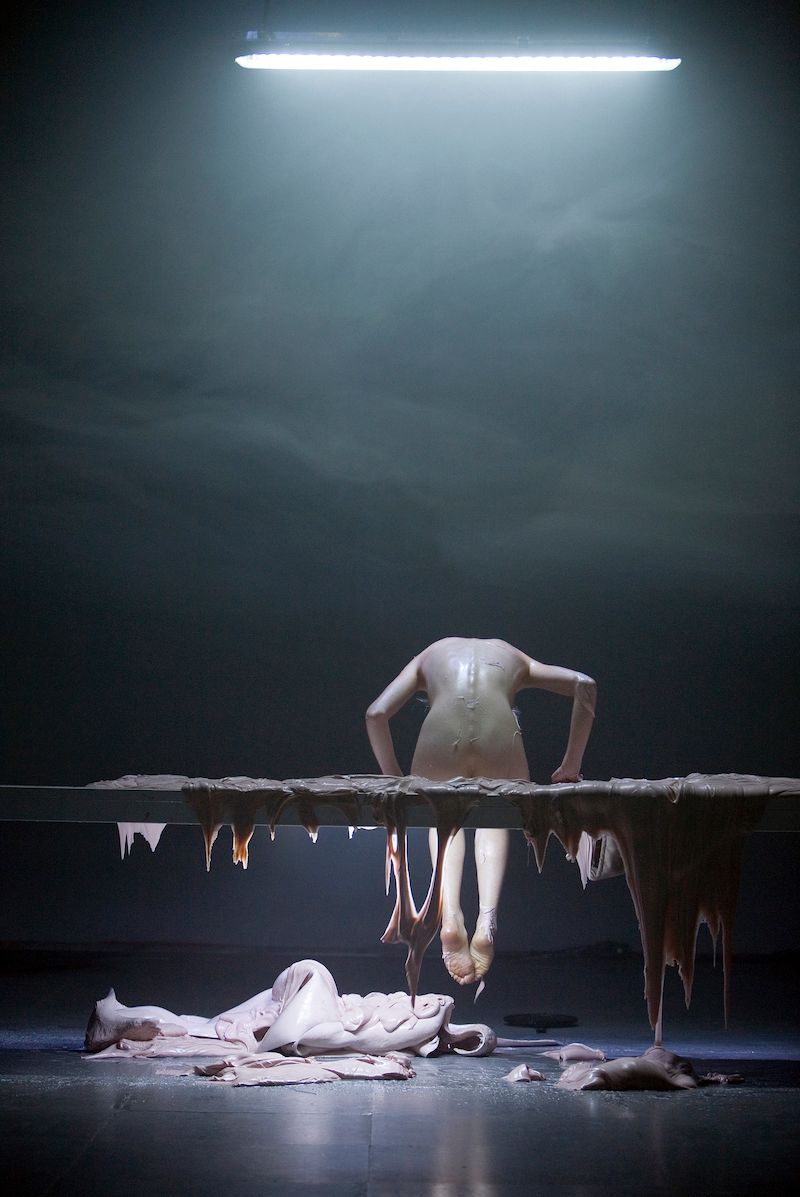
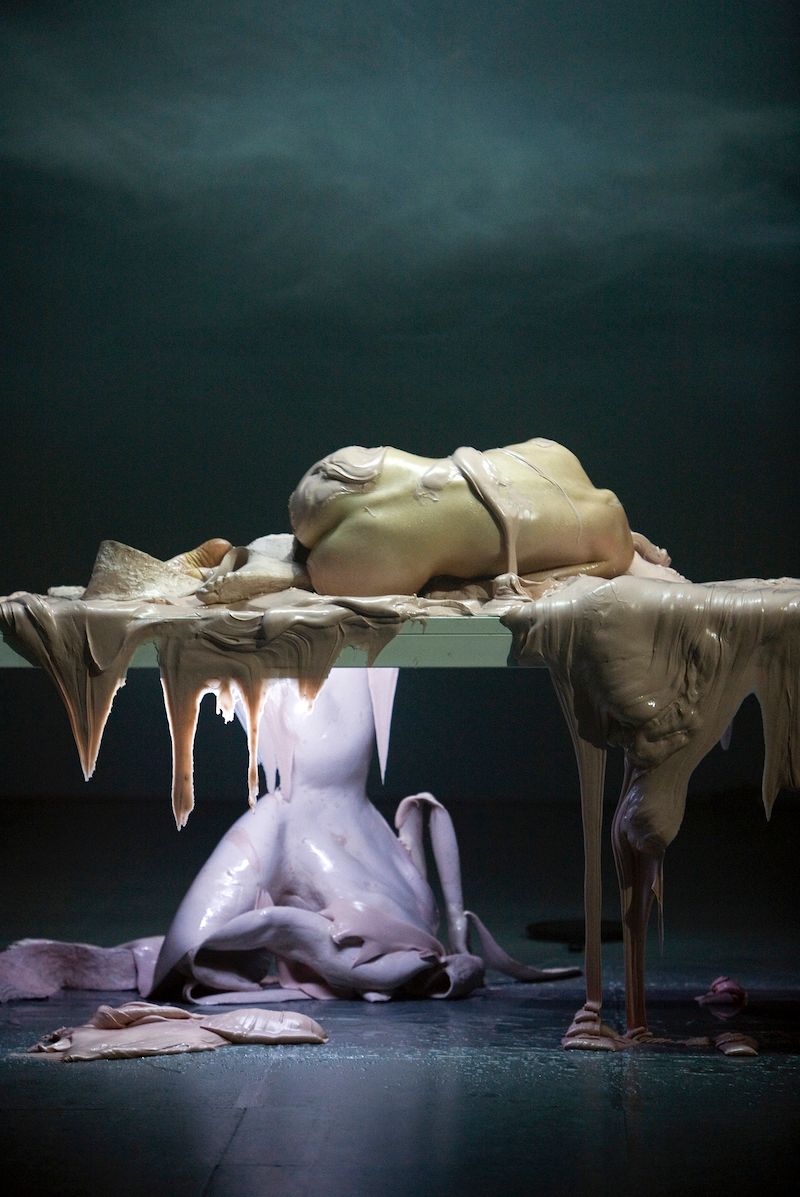
The opening scene from Hey Girl! by Romeo Castellucci
Somehow it all sounds familiar, yet none of it makes sense. This is the strength of the theatre of Romeo Castellucci. His work skirts sense from both sides: from nonsense, or the nonsensical, on the one hand, and from overdetermined symbolism on the other. As a viewer you are left to piece the different elements together into a coherent whole. Questions remain. There are always some symbols left over, while others are missing.
I must say that I prefer Romeo Castellucci's older, darker pieces for a small stage, such as Giulio Cesare and Genesi, From the Museum of Sleep. In these productions, when there wasn't much happening on stage, you could always lose yourself in the stage design, or at least you could in some scenes. I also found the symbolism in Hey Girl! a bit too obvious and the piece as a whole too predictable. But the opening scene alone is worth sitting through the entire piece for.