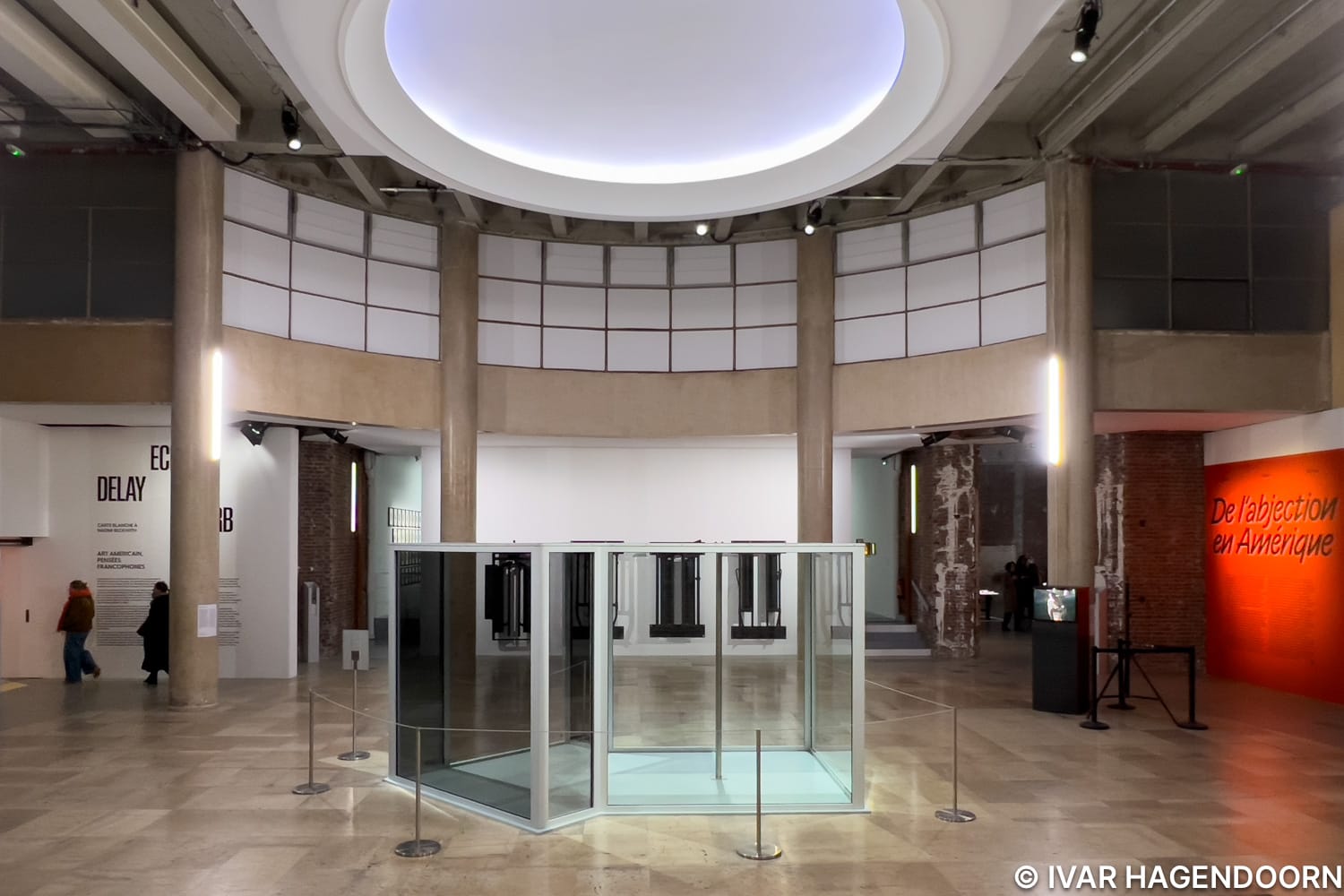
The Palais de Tokyo has organized an ambitious exhibition, "Echo Delay Reverb: American Art, Francophone Thought," which explores how, from the 1960s to the present, American artists absorbed the ideas of French (and francophone) thinkers and how these ideas were reshaped in the process. It is hard to imagine an institution outside France staging such an intellectual exhibition. The sprawling exhibition, comprising more than fifty artists across seven rooms, is curated by the Chicago-born art historian Naomi Beckwith—currently deputy director and chief curator of the Guggenheim Museum in New York and recently appointed artistic director of the next Documenta in 2027.
I rejoiced when I read the announcement for the exhibition, because my education in philosophy was heavy on Derrida, Deleuze, Foucault and Lyotard.
Beckwith's curatorial framework deliberately expands the constellation of what constitutes "French theory" beyond the canonical thinkers—Foucault, Derrida, Barthes, Lacan, Deleuze and Guattari, Baudrillard, and Kristeva—to encompass decolonial thinkers whose work emerged from France's former Caribbean and North African colonies, including Aimé Césaire and Frantz Fanon. The exhibition traces how French theory circulated through American academia before being reinterpreted, transformed, and re-exported by artists, emphasizing intellectual exchange as a dynamic and rhizomatic process rather than a unidirectional transmission.
By way of introduction, each thematic section—"Dispersion, Dissemination," "The Critique of Institutions," "Geometries of the Non-Human," "Desiring Machines," and "Abjection in America"—opens with a wall-covering collage featuring quotations, portraits of authors, and glass displays with first editions of key texts in English translation.
In some of the works on show the influence of French theory is instantly recognizable. For example, Bourdieu's ideas on cultural capital are reflected in the work of Hans Haacke and Andrea Fraser, and I would not be surprised if they had read Bourdieu. A series of untitled watercolors by Paul Chan show costume designs for “The History of Sexuality Volume One: An Opera”, a direct reference to Foucault. In other cases, the influence is more oblique, manifesting through form, affect, or metaphor, such as in the works that respond to the writings of Kristeva and Barthes.
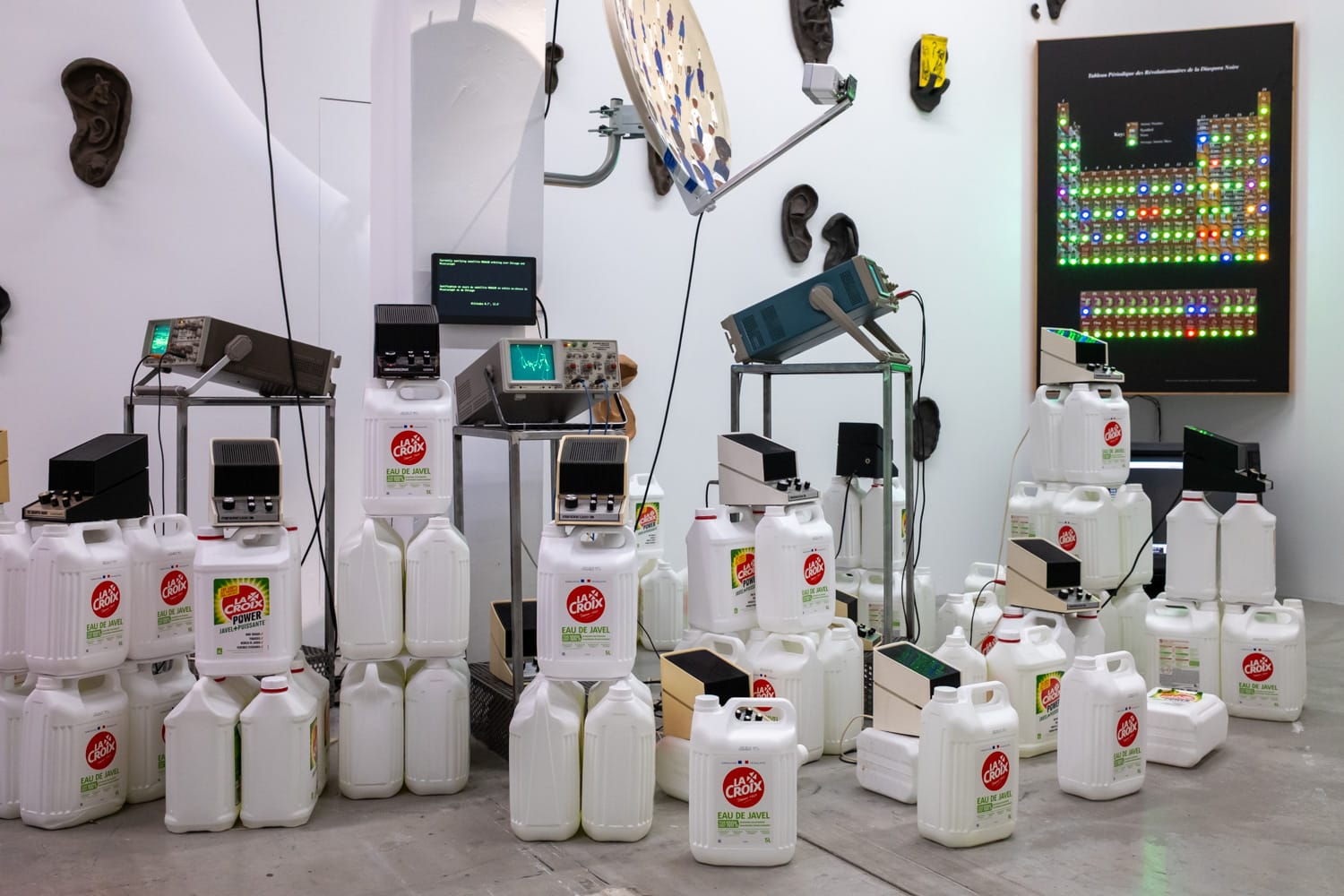
Inevitably, in an exhibition of this scale, not all works are equally strong. I could not care much for the works in the section on "Desiring Machines," but that probably says something about my own interests. This was more than made up for by a fascinating room-filling installation by Char Jeré. (Site-specific installations are always one of the Palais de Tokyo's greatest strengths).
As is to be expected in an exhibition dedicated to French theory, several works take text and language as their subject, such as the wonderful installation by Kameelah Janan Rasheed conceived especially for the exhibition. It takes as its starting point the story of the British-Caribbean twin sisters June and Jennifer Gibbons who grew up in a small village in Wales in the 1960s and who developed a private language only they could understand to protect themselves against a hostile outside world.
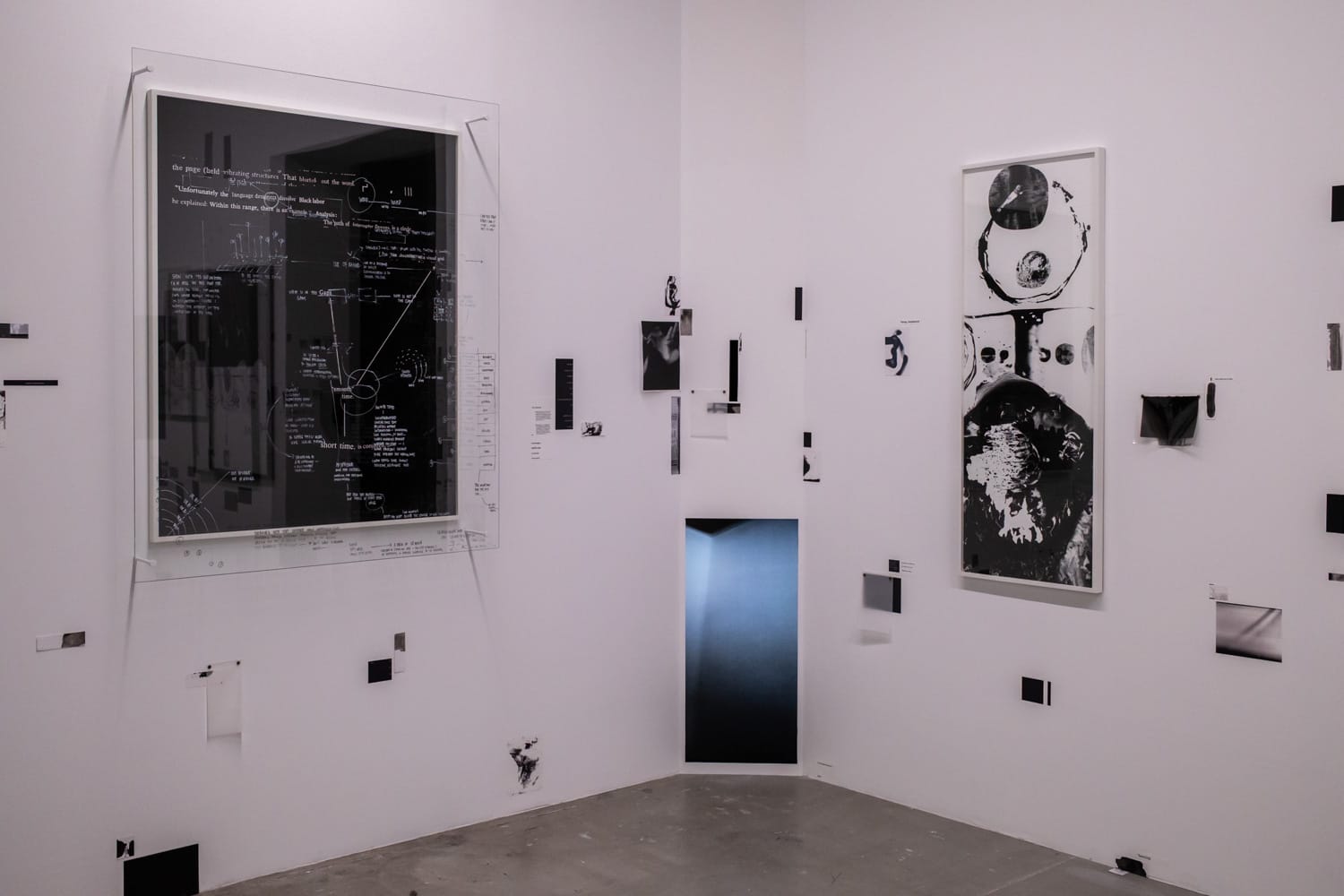
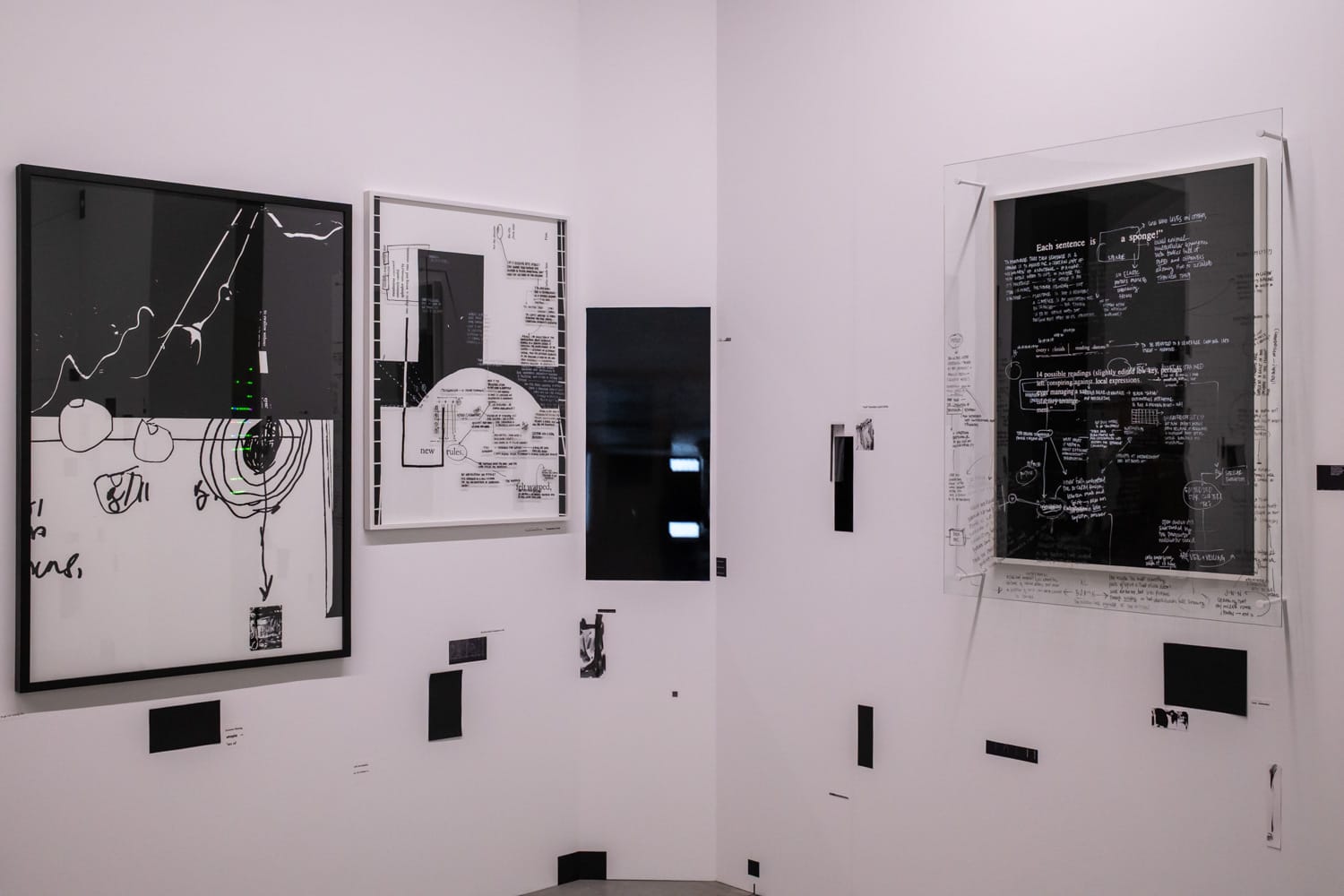
Kameelah Janan Rasheed, Out of Bounds (2025)
At times, the philosopher in me, steeped in post-structuralism, objected to the ways the work of certain thinkers had been appropriated. But there is something to be said for Beckwith's framing of intellectual influence as a space of poetic distortion and creative reinvention rather than fidelity.
My one other reservation is that the exhibition focuses almost exclusively on the visual arts and completely ignores the tremendous impact of both Derrida and Deleuze on American architecture—a missed opportunity, I think, even though it would have made a large exhibition even larger. (Across town, at the Parc de la Villette you can still see the impact of French thought on American architecture. The theoretical principles behind the park's design by Bernhard Tschumi were informed by the work of Derrida. Originally, the scheme also included a garden jointly designed by the American architect Peter Eisenman and Derrida).
While its formidable scale and conceptual breadth at times strain the curatorial framework, "Echo Delay Reverb" affirms the transformative potential of ideas as they move across disciplines, geographies, and historical contexts. The exhibition stands as a forceful argument for intellectual openness and self-directed meaning-making at a moment when cultural discourse is increasingly constrained.
ECHO DELAY REVERB : Art américain, pensées francophones is at the Palais de Tokyo in Paris until 15 February 2026.