In 1993, while I was still at university, I visited a solo show of Gerhard Richter at the Musée d'Art Moderne de la Ville de Paris, as it was then called, which at the time was the largest retrospective of Richter's work. It had a profound influence on me. To this day Gerhard Richter remains one of my favorite visual artists. Two years later, in 1995, the Anthony d'Offay Gallery in London organized a show with new work by Gerhard Richter. At the time I was enrolled as a graduate student at University College London, but I somehow found the time to go to the opening. Richter was there as well. He just stood there, together with Anthony d’Offay and another person, holding a glass of wine. Everybody recognized him, but no one dared approach him. So I gathered all my courage and told him that I greatly admired his work. He was most forthcoming and gestured a waitress to offer me a glass of wine.
In the years since I've seen his work in various museums—his work is, of course, particularly well represented in Germany—and I own several monographs of his work, but I’d been looking forward to another large retrospective. Unfortunately I missed the retrospective at the Tate Modern and the Centre Pompidou in 2011-12 and due to the COVID-19 pandemic I was unable to go to the 2020 retrospective at the Metropolitan Museum of Art in New York. My wish has finally been fulfilled, because the Fondation Louis Vuitton is currently presenting the largest retrospective ever dedicated to Gerhard Richter, featuring 271 works spanning six decades.
The exhibition, curated by Sir Nicholas Serota and Dieter Schwarz, brings together exceptional loans from museums across Europe, the United States, and Asia, including the "Birkenau" series, on loan from the Neue Nationalgalerie in Berlin, and the entire “October 18, 1977” series, on loan from New York’s Museum of Modern Art. Arranged chronologically across the Foundation's four floors, the retrospective traces Richter's evolution from his self-designated "first" painting to his declared "last" in 2017, when he laid down his brush at age 85.
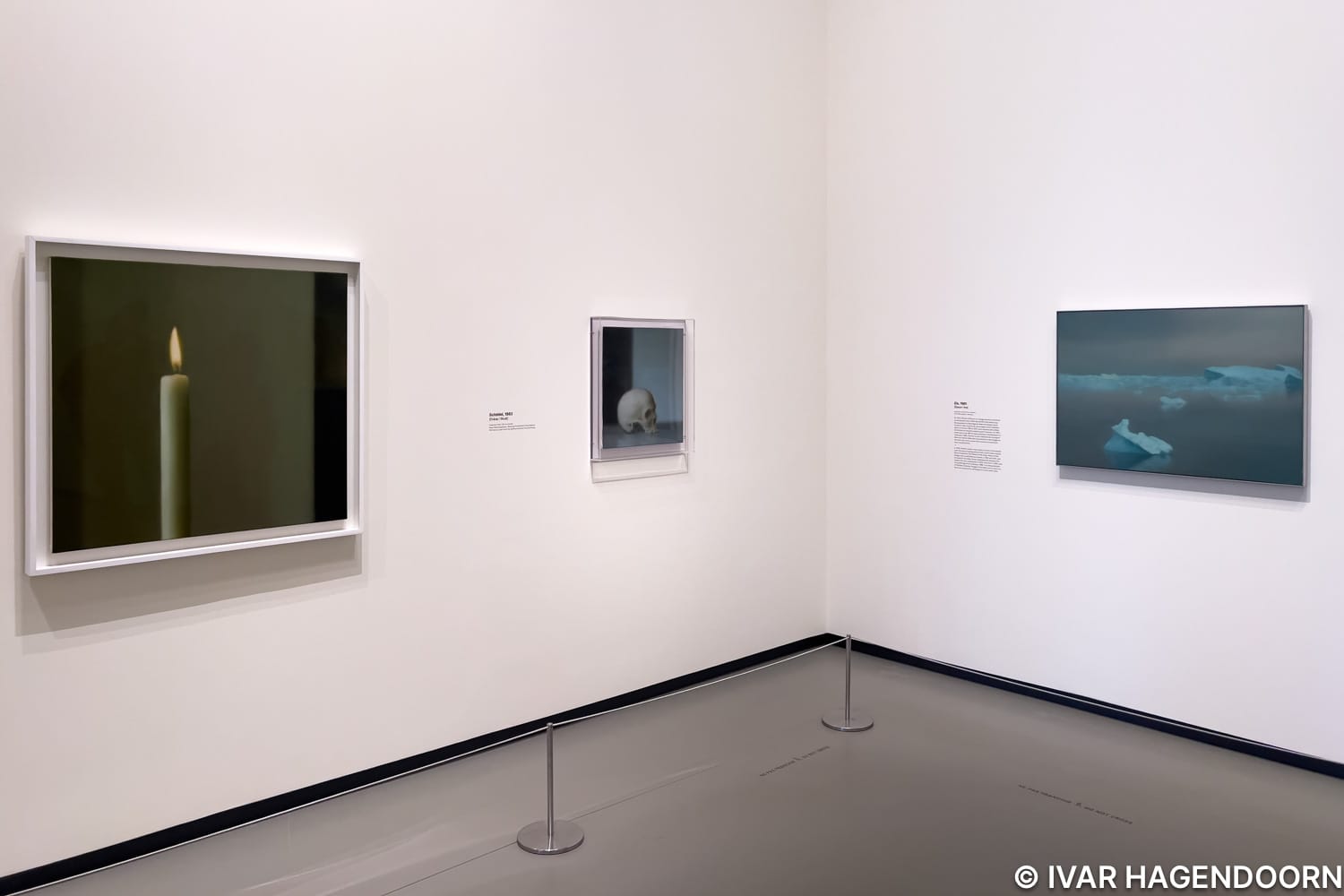
Born in Dresden in 1932, Richter has won both the Golden Lion at the Venice Biennale and the Praemium Imperiale in 1997, cementing his reputation as one of the most significant painters of our time. Richter's artistic journey began in earnest after he fled communist East Germany for Düsseldorf in 1961, deliberately destroying all his earlier work and starting afresh. His breakthrough came with photo-paintings rendered in distinctive grisaille tones, blurred images derived from family snapshots, press photographs, and magazine clippings. These works carry profound historical weight: portraits of his uncle Rudi in Wehrmacht uniform, his aunt Marianne who was murdered in the Nazi euthanasia program, and his father-in-law who participated in forced sterilizations confront Germany's collective silence about its Nazi past. The trademark blur that defines these paintings serves multiple purposes—evoking the fallibility of memory, the fleetingness of perception, and the artist's own ambivalent attitude towards art, representation and reality at large.
The exhibition includes several cycles that demonstrate Richter's unflinching engagement with history's darkest chapters. "October 18, 1977" (1988) comprises fifteen blurred paintings in the form of diptychs, triptychs and single canvases based on press photographs of the Baader-Meinhof Gruppe, the four founding members of the far-left Rote Armee Fraktion (RAF), which in the early 1970s had carried out numerous terrorist attacks and kidnappings across Germany. They were eventually arrested and sentenced. But on October 18, 1977 they were found dead in their prison in Stammheim, Germany. Did they simultaneously commit suicide or were they killed?
When it was first exhibited the series met with considerable criticism, especially in Germany, but today it is widely regarded as one of the darkest and most disconcerting works of modern times. It used to hang in Frankfurt’s Museum für Moderne Kunst, where I saw it whenever I travelled to Frankfurt to see a performance by the Ballett Frankfurt. Inexplicably, at least to me, Richter sold the series to the Museum of Modern Art in New York in 1995. I was delighted to finally see the entire cycle again.
One of the final rooms in the exhibition is dedicated to the "Birkenau" series, four monumental canvases begun as reproductions of clandestine photographs taken at Auschwitz, which are also included in the exhibition, but ultimately overpainted into abstraction—an erasure of an erasure, rendering the unthinkable unpaintable. Installed opposite towering mirrors, these works implicate viewers as witnesses, forcing them to confront history reflected against this abstraction of terror.
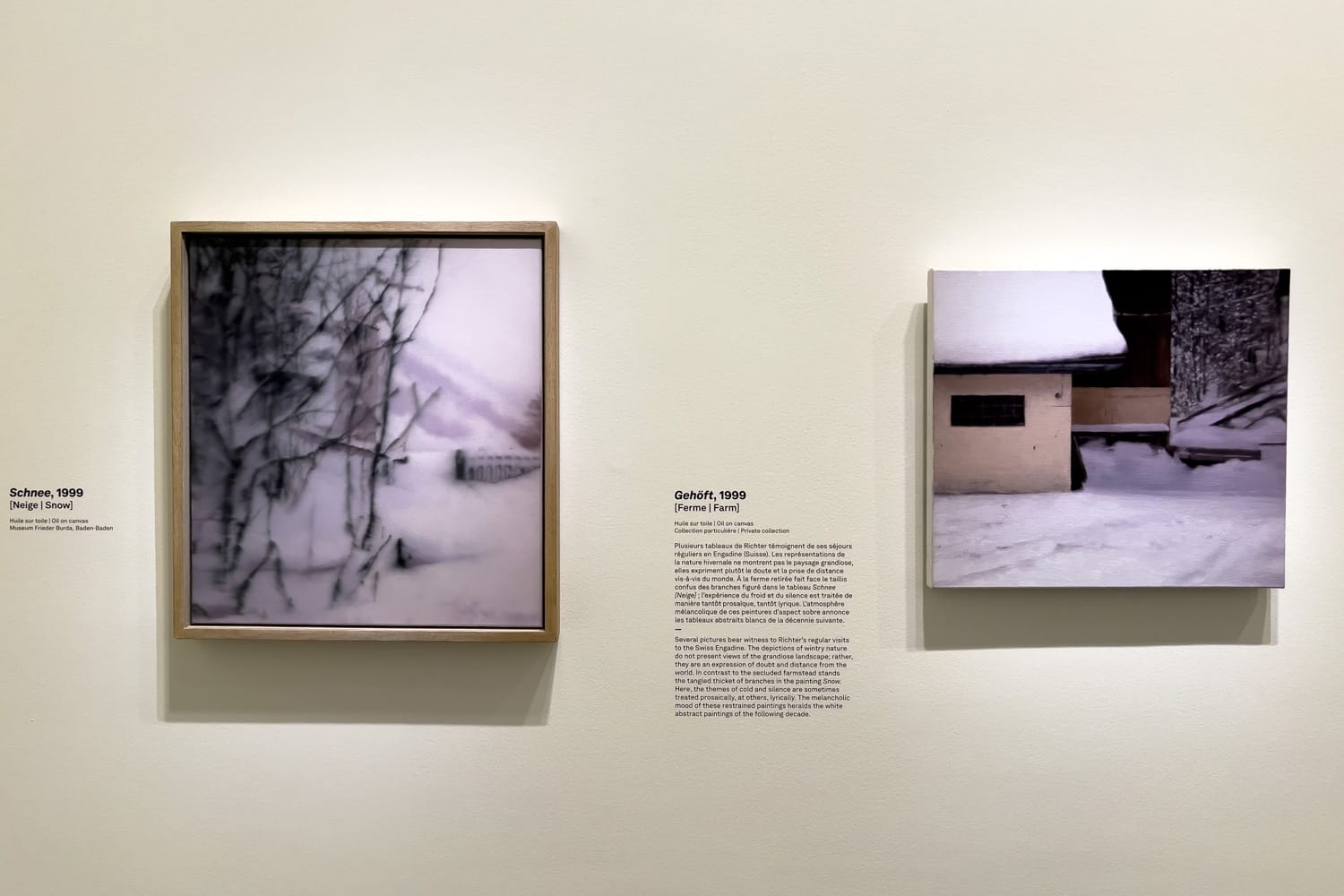
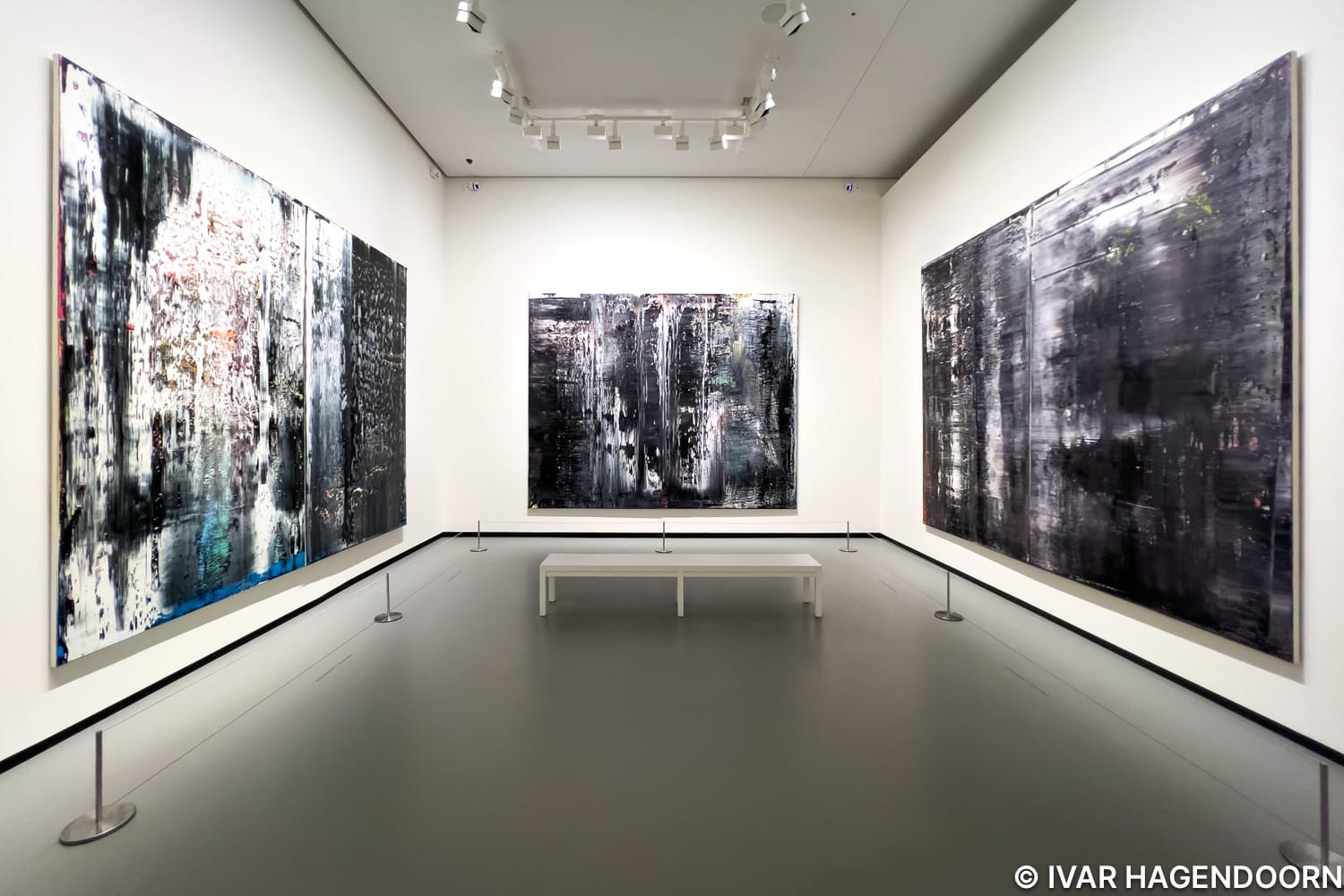
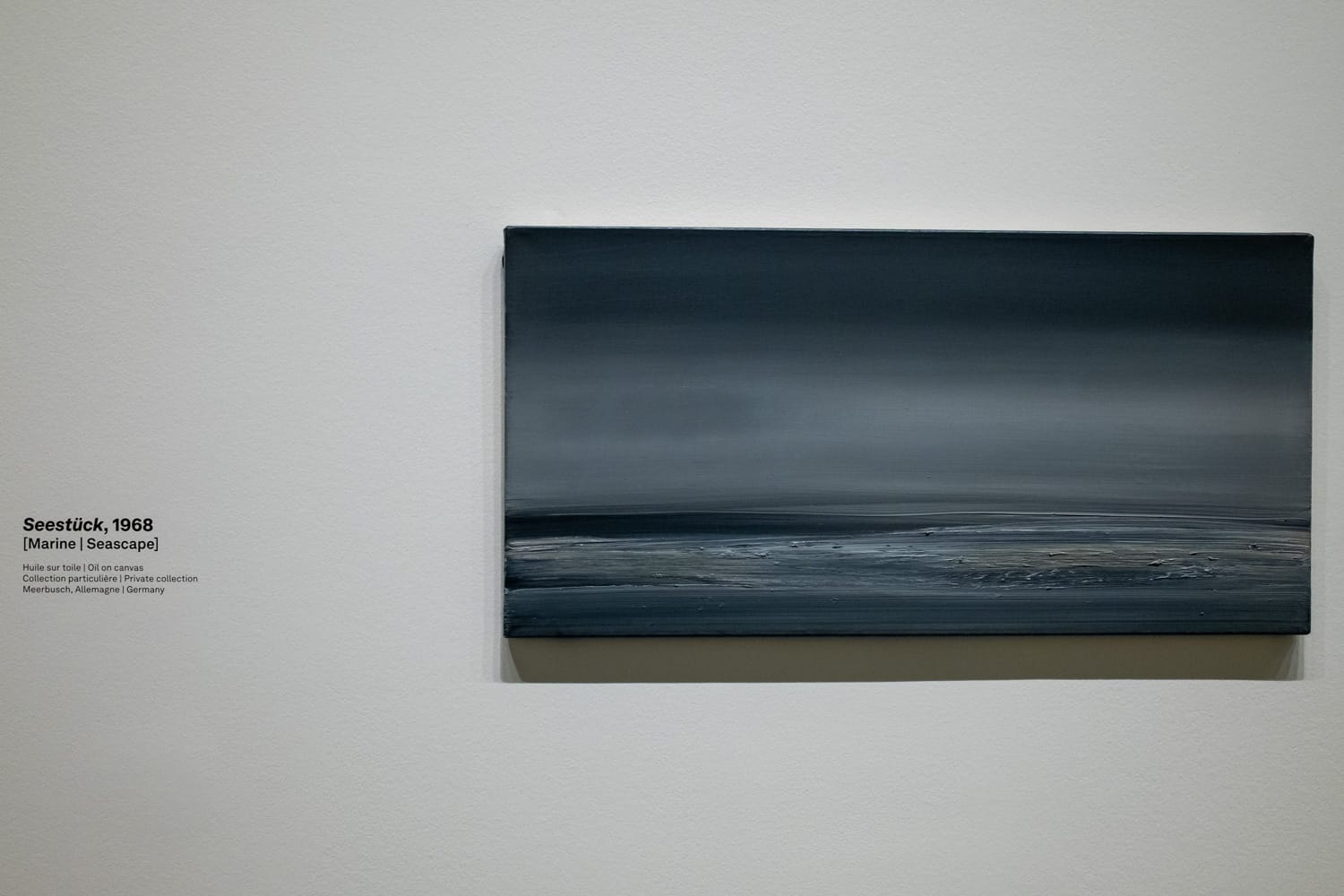
What distinguishes Richter from virtually all his contemporaries is his stubborn refusal to choose between abstraction and figuration, those supposedly irreconcilable antagonists in postwar art. This too is what I’ve always admired in Gerhard Richter, perhaps because it reflects my own inability to choose between, or to reconcile, my drive towards abstraction and my love for dirty realism on the one hand and the sublime in nature on the other. While critics and movements demanded allegiance to one camp or the other, Richter practiced both simultaneously, sometimes within the same canvas. Some of his paintings question the notion of abstraction and figuration, as in "Seestück" (1968). The title makes it a figurative painting. Ignore the title and it could pass for an abstract work.
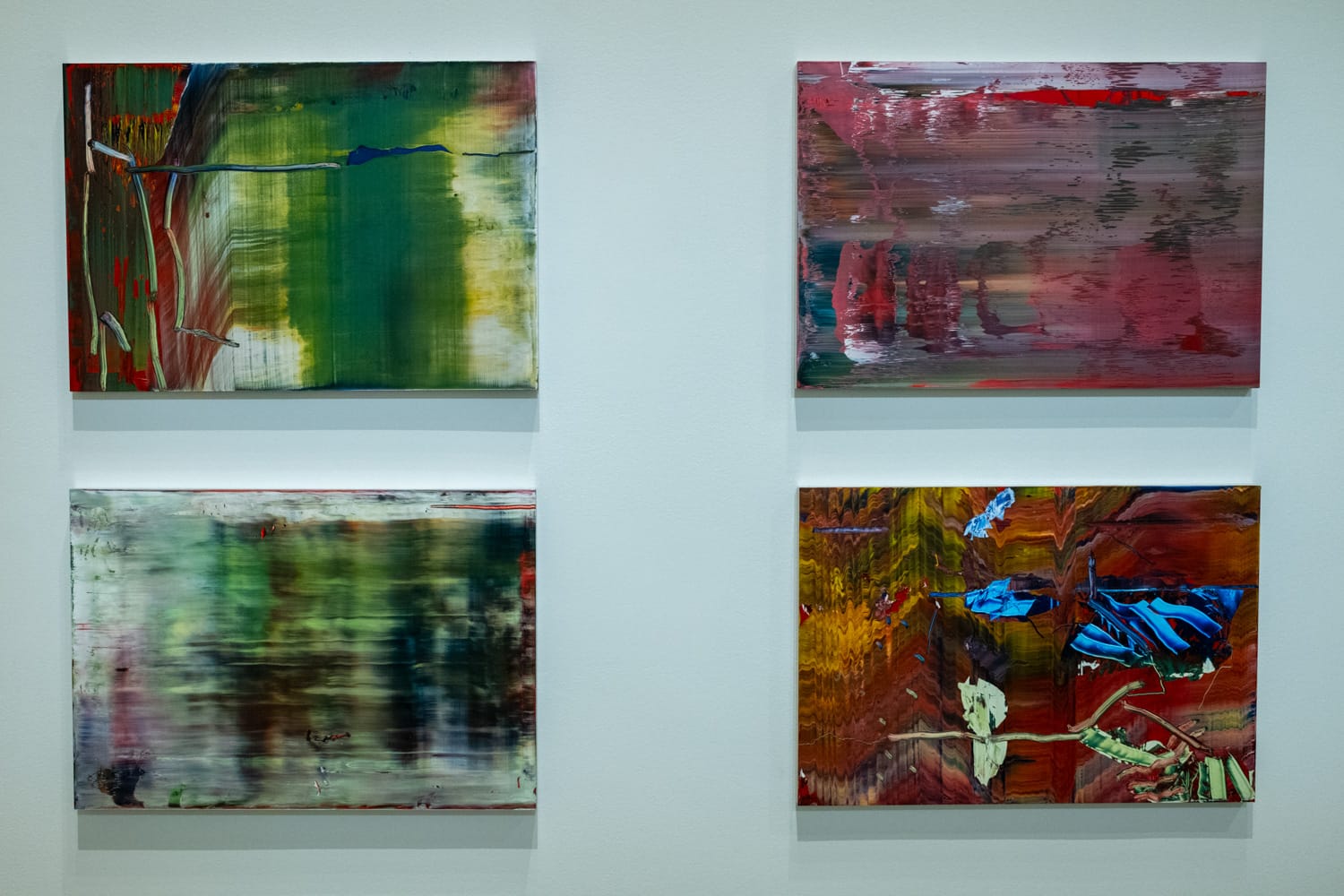
Richter's abstract vocabulary encompasses three distinct approaches: geometric grids culminating in the 11,500-square stained-glass windows for Cologne Cathedral, monochrome paintings that make "nothing" visible, and gestural works created by dragging squeegees across wet paint to produce iridescent, beguiling surfaces. This systematic experimentation, conducted with almost scientific rigor, as can be seen in the documentary “Gerhard Richter: Painting” (2011), has made him arguably the most complete abstract painter of his generation. I’ve loved the “squeegee” paintings ever since I first saw them and fortunately the exhibition includes a generous selection from various periods.
(By the way, the 1995 show at the Anthony d'Offay gallery was accompanied by a catalogue, which, in an appendix, documented the various stages of one of Richter's "squeegee" paintings. Unfortunately it was never published, because it didn't meet Richter's exacting standards. I remember going back to the gallery several times to inquire about the date of publication, without ever receiving the longed for positive response. So I only saw the pre-print that was on display during the opening. I still remember it and I so wanted to own a copy, because to me every intermediate stage looked great and so it raised the question: when does an artist, in this case Gerhard Richter, consider a work finished? At some point in "Gerhard Richter: Painting" the interviewer asks a similar question, which of course Richter is unable to answer.)
Throughout his career, Richter has maintained a dialogue with art history. His "Toilet Paper" (1965) responds to Andy Warhol, while "Ema (Nude on a Staircase)" (1992) refers to Marcel Duchamp, and five increasingly abstracted renderings of Titian's "Annunciation" explore the perfection that contemporary painting can no longer achieve. Yet alongside this conceptual rigor exists unexpected tenderness: portraits of his wives and children glow with Vermeer-like grace, their soft focus conveying intimacy rather than historical distance. A postcard of “Lesende” (1994), a contemporary “Girl with a Pearl Earring”, has been on my bookshelf for years — I just have to turn my head to see it — and it was a joy to see it in reality again. The exhibition also reveals how differing works illuminate one another, as when "Betty" (1988) depicting his daughter turning toward one of his grey monochromes, crystallizes the relationship between figuration and abstraction that defines his oeuvre.
The final room offers six abstract paintings from 2016-17, some radiant rainbow harmonies, others meditations on single hues of deep crimson and luminous yellow. These final works astonish with their almost elegiac beauty, providing hope after the darkness of the ”Birkenau" series in the previous room and suggesting an artist who, having spent decades questioning what images can do, ultimately surrendered to their capacity for pure bliss.
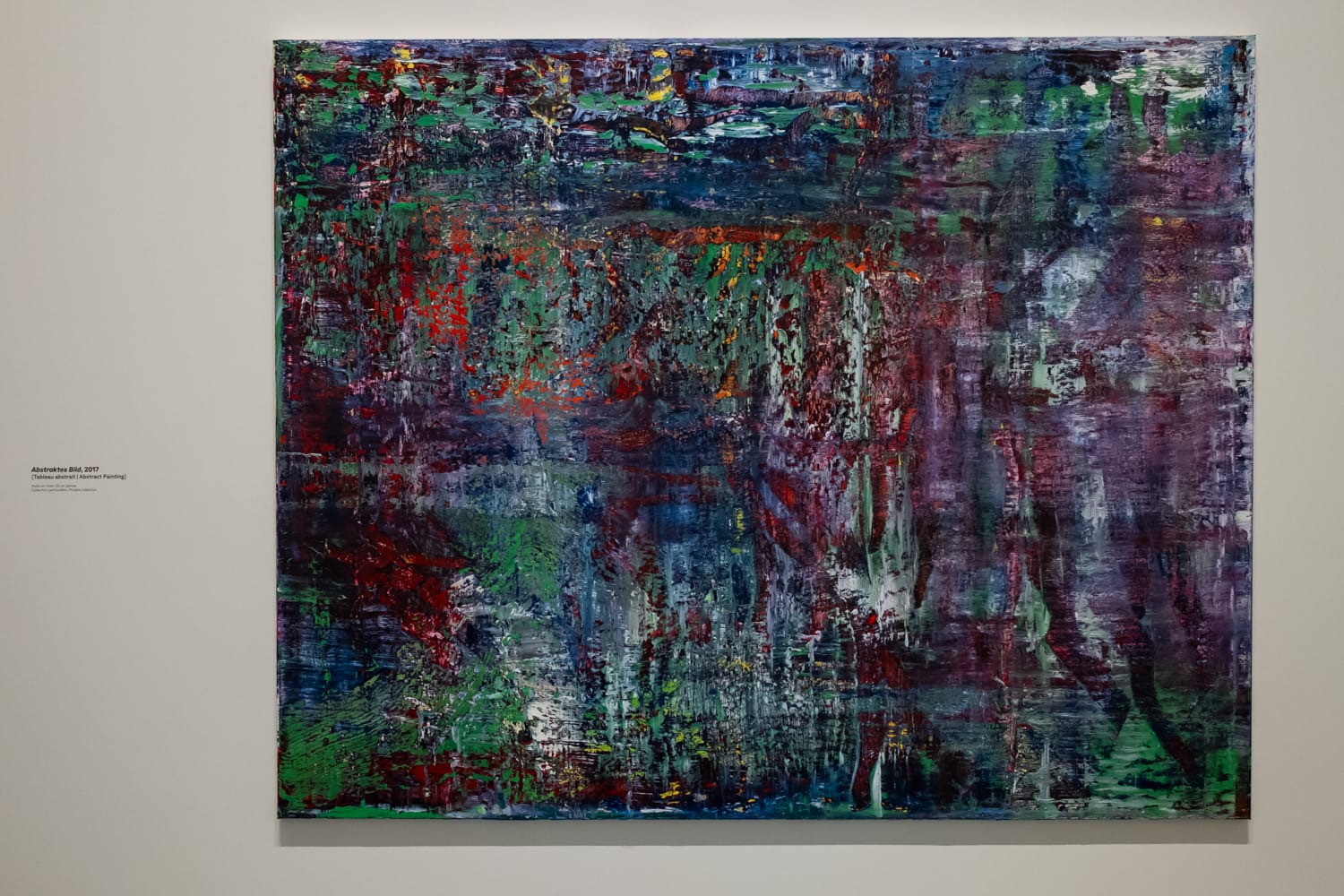
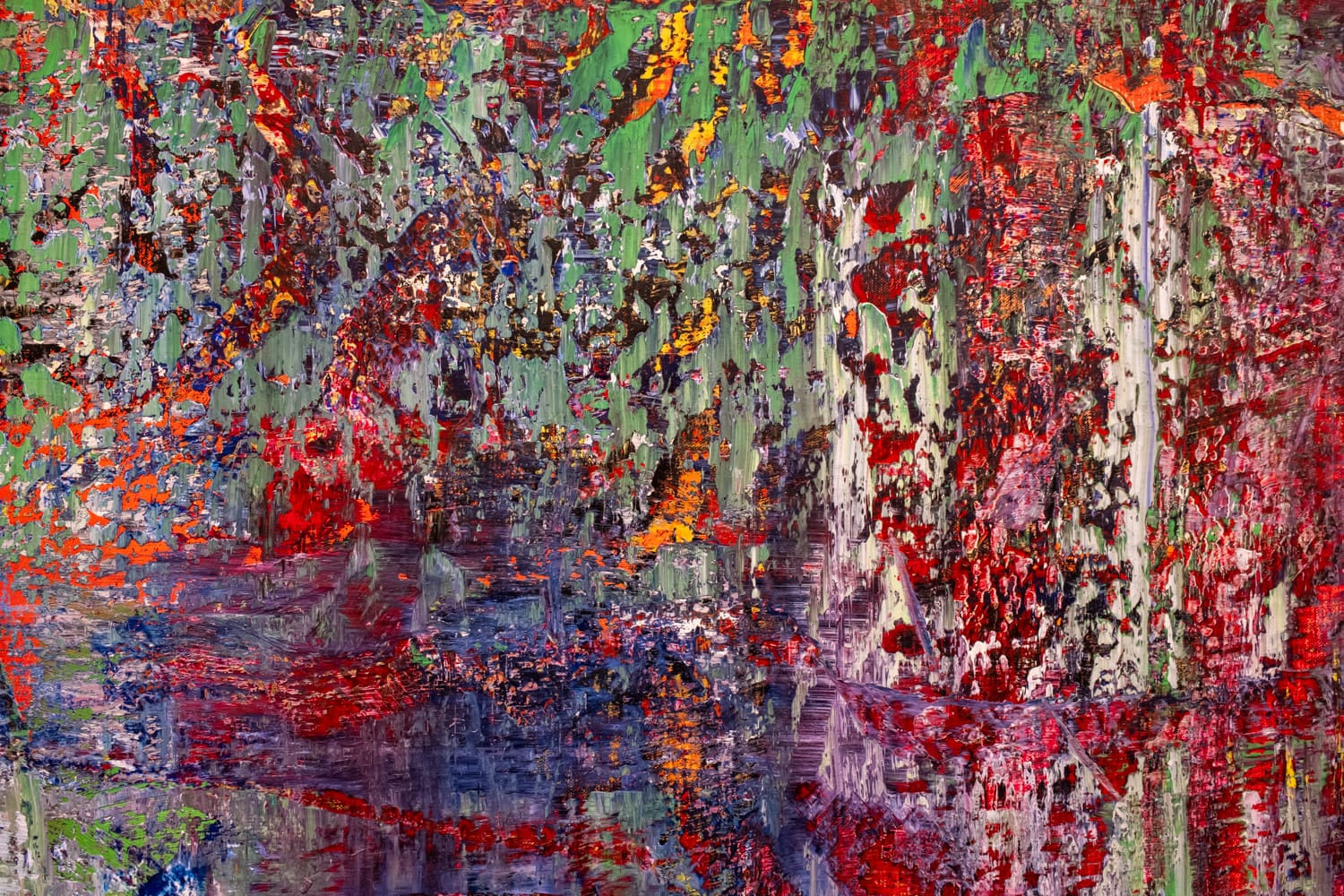
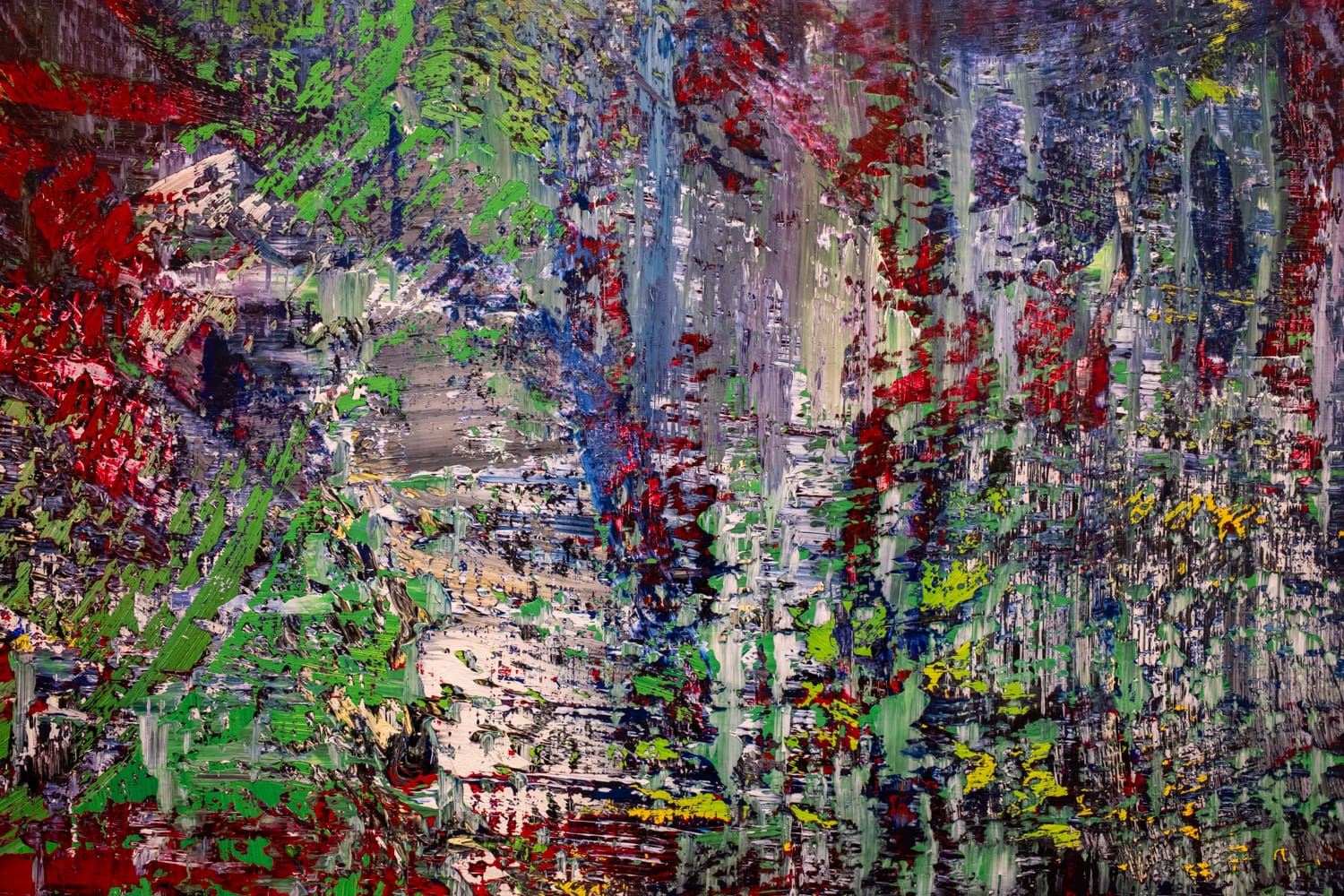
Gerhard Richter, "Abstraktes Bild" (2017) (left), details (middle and right)
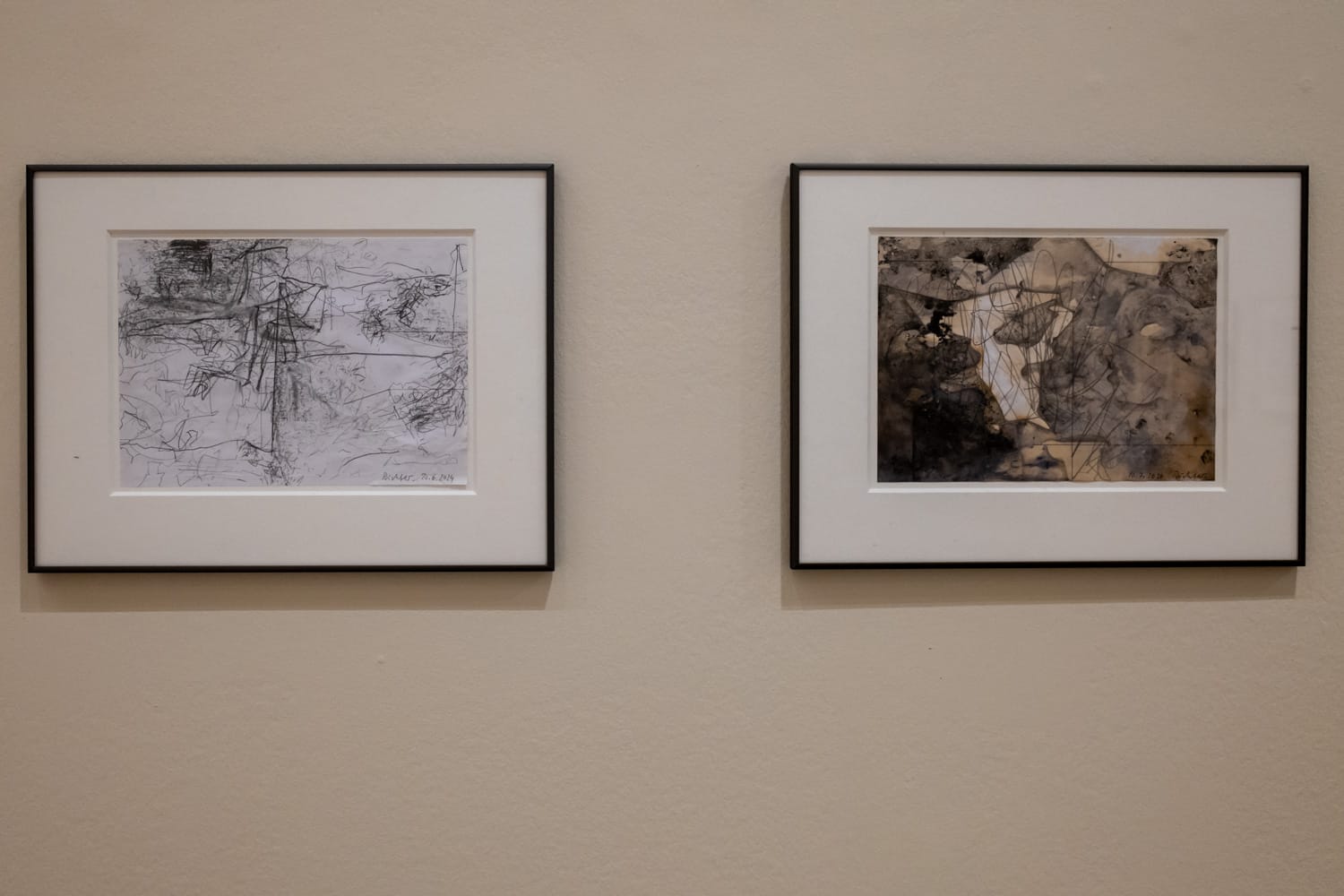
In 2017, Gerhard Richter declared his painted oeuvre complete and quit painting. He continues drawing though and the exhibition includes a number of his recent intricate drawings, which I found surprisingly inspiring. The lines look the way I imagine my thoughts look: chaotic yet somehow structured.
The exhibition is accompanied by various publications, including a lushly illustrated catalogue published by the French independent publisher of beautiful but hugely expensive art books Citadelles & Mazenod. The Gerhard Richter catalogue is reasonably priced though.
Gerhard Richter is at the Fondation Louis Vuitton until 2 March 2026.
Related Posts
More blurred images: Dans le flou at the Musée de l'Orangerie.