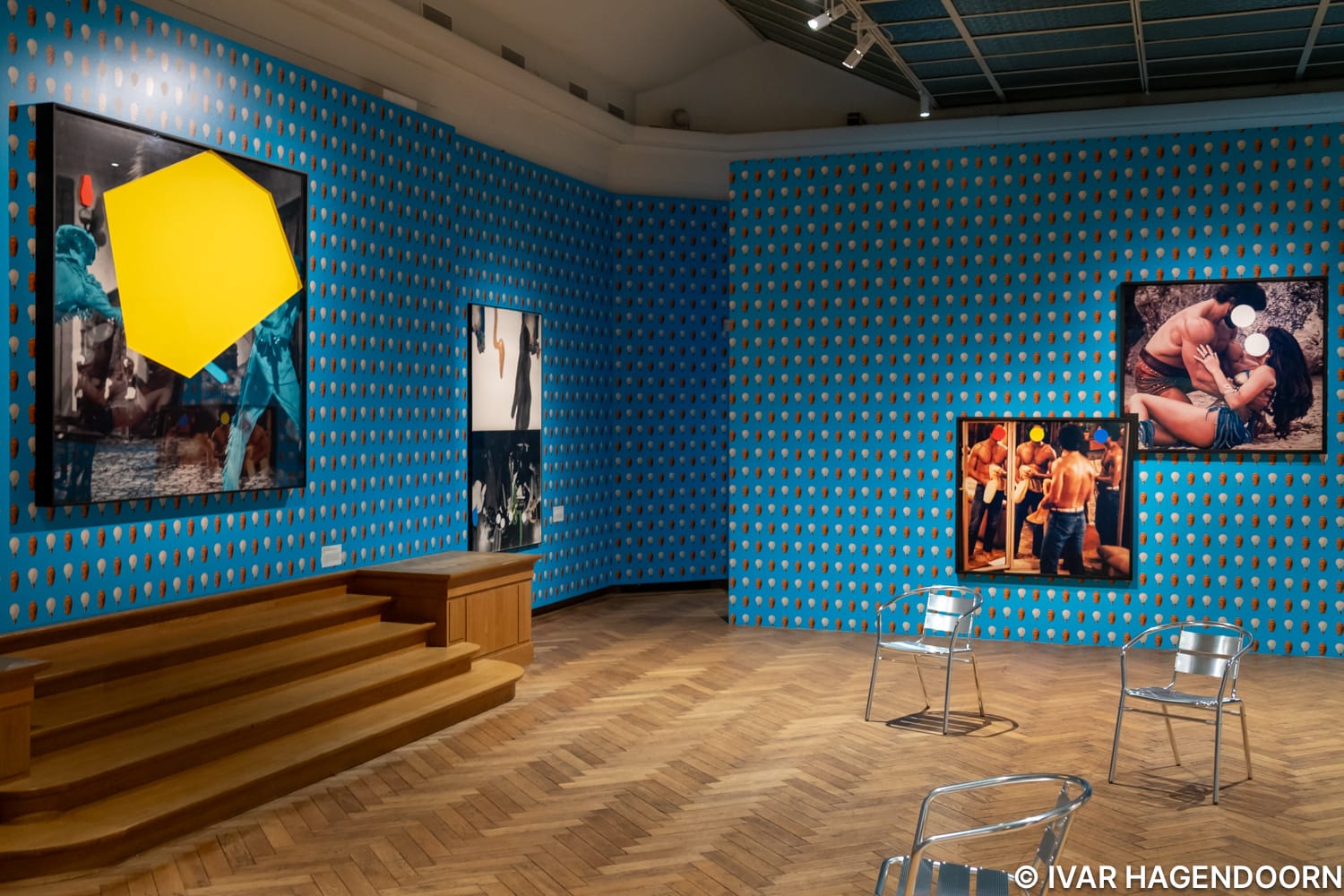
At the last minute and just before it closed I visited the John Baldessari exhibition "Parables, Fables and Other Stories" at BOZAR in Brussels. I’m glad I did, because it was a fun show. I had missed the Baldessari retrospective at Tate Modern in 2009, which subsequently travelled to LACMA in Los Angeles and The Metropolitan Museum of Art in New York, so I had been keen to visit the exhibition at BOZAR.
John Baldessari (1931–2020) was a pioneering American conceptual artist whose restless intellect and irreverent wit reshaped the boundaries of contemporary art. Born in National City, California, to a Danish mother and Austrian father, Baldessari trained as a painter before growing disillusioned with the medium's perceived exhaustion. In a now-legendary act of artistic reinvention, he incinerated the paintings he had accumulated between 1953 and 1966, delivering the canvases to a crematorium and preserving their ashes in a bronze urn — even baking cookies from the remains and sending them to fellow artists. Though the mythology surrounding this "cremation" has grown over the decades, the truth is somewhat more pragmatic: he was relocating to teach at CalArts and simply destroyed the works he chose not to carry forward. Nevertheless, the gesture crystallized his metamorphosis into a conceptual artist who privileged ideas, language, and narrative over painterly tradition.
The exhibition "Parables, Fables and Other Stories" at Bozar illuminates Baldessari's gift for storytelling and his conviction that language could serve as paint. From his early work “Ingres and Other Parables” (1972), in which black-and-white photographs are paired with multilingual fables, to the video “I Will Not Make Any More Boring Art” (1971) — a half-hour loop of the artist inscribing the same sentence — the show traces his lifelong fascination with the interplay of word and image. Baldessari drew deep inspiration from Goya's satirical “Los Caprichos” etchings, adopting both their fusion of visual and verbal registers and their mordant humor. He channeled this sensibility into works that subvert expectation, such as in a photograph of a dead plant captioned "That Always Happens" and a photograph of a bouquet of flowers captioned “There Isn’t Time”.
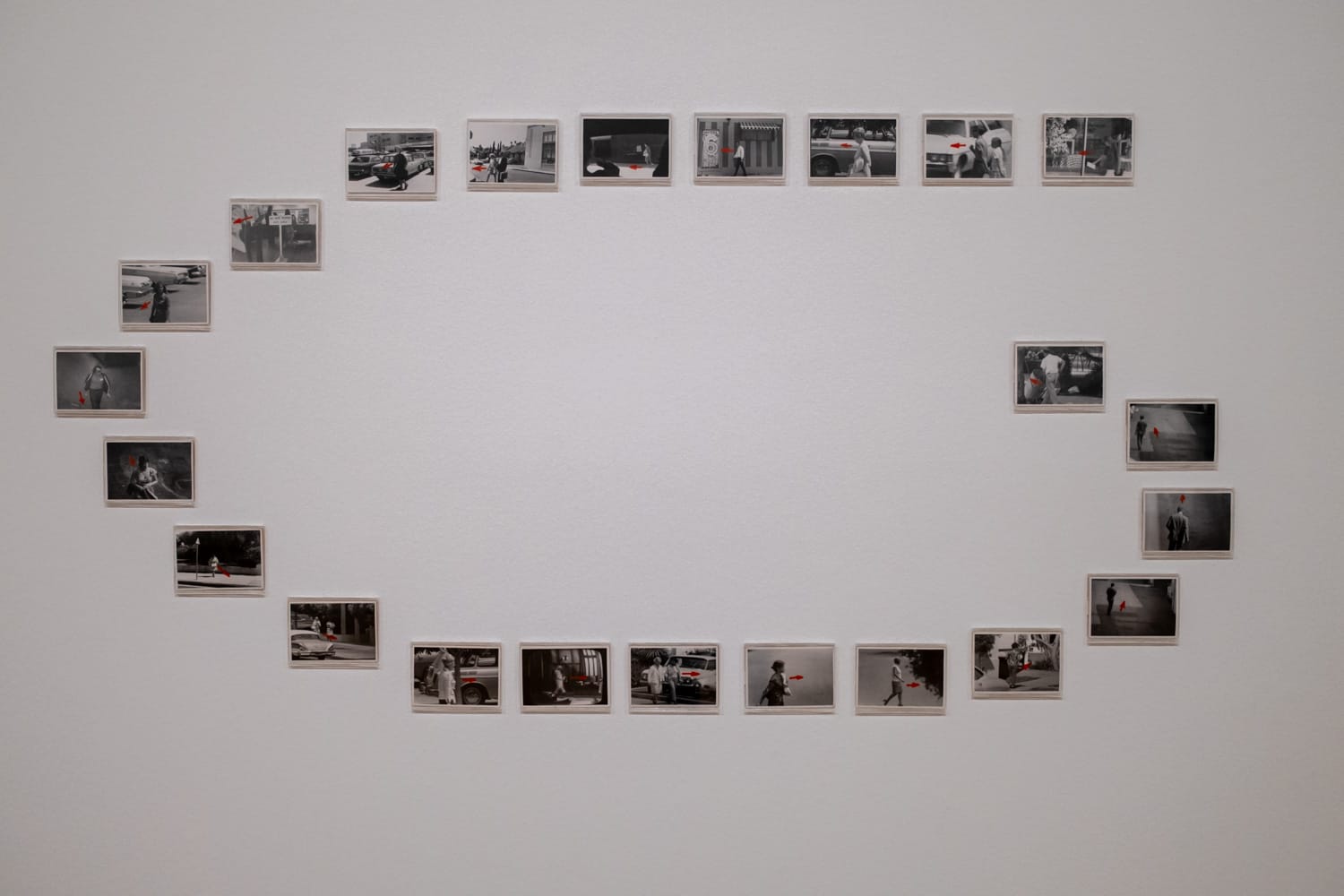
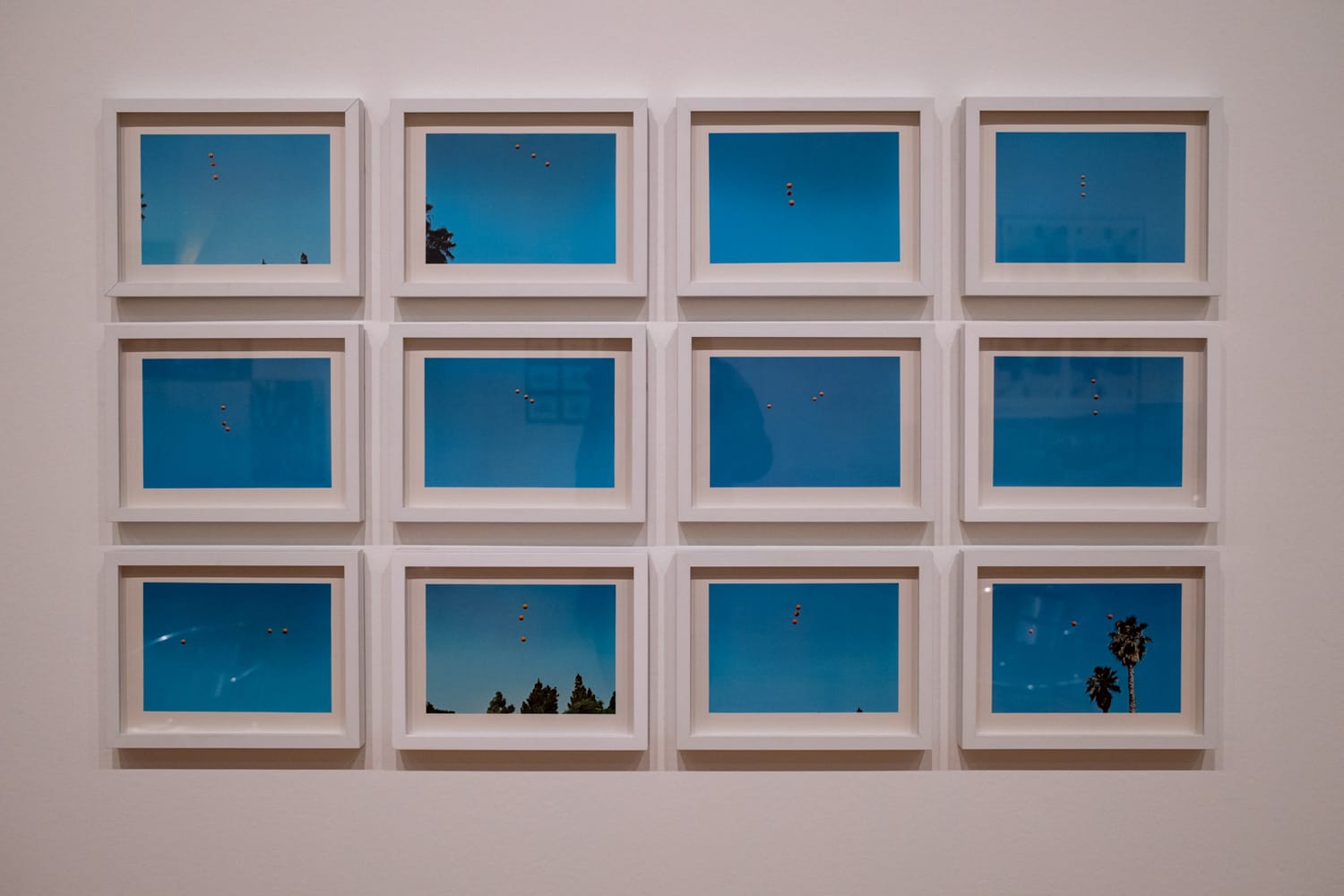
John Baldessari, “A Movie. Directional Piece Where People Are Walking” (left) and “Throwing Three Balls in the Air to Get a Straight Line” (right)
Whereas other conceptual artists, such as Joseph Kosuth and Lawrence Weiner, were dead serious, John Baldessari had a great sense of humor. I loved the photo series in which he is seen waving at boats sailing by.
Photography became Baldessari's primary medium after 1970, yielding iconic series such as “Throwing Three Balls in the Air to Get a Straight Line”, a sequence of twelve images capturing geometric chance against a luminous California sky. By the mid-1970s, he had largely abandoned the camera in favor of found imagery — scavenging Los Angeles for discarded newspapers, film stills, and advertising photographs, which he meticulously catalogued and recombined to generate fresh narratives. He manipulated these appropriated images with a Xerox copier, obscured figures with colored dots, and shattered conventional rectangular formats in favor of triangles and polygons.
Baldessari's artistic hero was not Warhol or Johns but filmmaker Jean-Luc Godard, whose dictum that a story needs a beginning, middle, and end — though not necessarily in that order — became a guiding principle for Baldessari's non-linear, open-ended compositions.
The Bozar exhibition honors this philosophy by eschewing strict chronology, with the first and final room serving as either entrance or exit depending on which way you enter. The installation is visually sumptuous, with specially designed Baldessari wallpaper pairing whimsical shape analogies — an ear and a pretzel, a clock and a pizza — and metal chairs positioned to encourage prolonged contemplation. It is a fitting tribute to an artist who championed boredom as a gateway to intellectual freedom and who insisted that the true essence of art resides not in the object itself but in the exchange between work and viewer. More than fifty years after Baldessari vowed never to make boring art again, this playful and intellectually stimulating retrospective confirms that he kept his promise.
John Baldessari: Parables, Fables and Other Stories was at BOZAR in Brussels until 1 February 2026.
Links
A Brief History of John Baldessari, narrated by Tom Waits, is an excellent introduction to the work of John Baldessari.
By the time you read this the exhibition at BOZAR will be closed, but autumn 2026 the UCCA Center for Contemporary Art in Beijing will organize the first John Baldessari retrospective in China.