Opera as an art form is perennially derided as obsolete — a rarefied indulgence catering exclusively to the cultural and intellectual elite. Its detractors are equally quick to point out that the genre could scarcely survive without subsidies and corporate patronage, conveniently overlooking that the same could be said of major sporting spectacles such as the Olympics and the World Cup. At the very least, opera houses tend to outlast most Olympic venues.
Perhaps in response to this persistent scepticism, directors such as Peter Sellars, Calixto Bieito, and Frank Castorf have each, in their distinctive idioms, gone to considerable lengths to demonstrate opera's enduring vitality as an art form. Certain composers, too, have turned their attention to contemporary subject matter — John Adams's Nixon in China and The Death of Klinghoffer being among the most prominent examples.
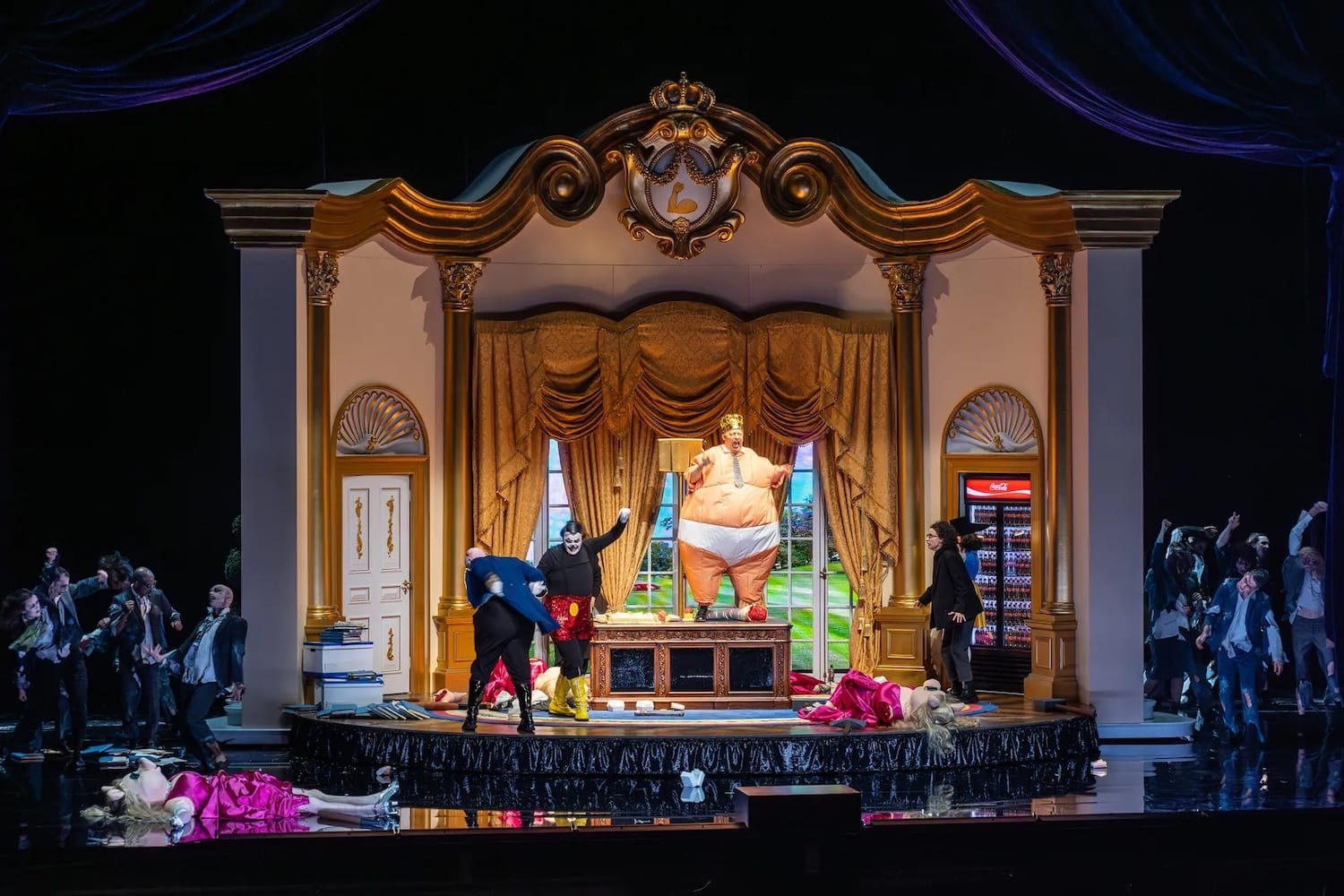
Monster's Paradise, the latest collaboration between composer Olga Neuwirth and Nobel laureate Elfriede Jelinek, directed by Tobias Kratzer and premiered at the Staatsoper Hamburg in February, satisfies both imperatives. Jelinek's libretto casts a wide and unsparing net, encompassing everything from Trump to the climate crisis and the pathologies of social media addiction. It is worth noting that Neuwirth began composing the opera several years ago, during the Biden administration; Kratzer, by contrast, enjoyed considerably more latitude to orient the production toward the present moment. The work reminded me of Kein Licht by Philippe Manoury, directed by Nicolas Stemann — and perhaps not coincidentally also based on texts by Jelinek — which served as a commentary on the first Trump presidency, social media bubbles, the Fukushima nuclear disaster, and climate change.
Monster's Paradise is billed as a Grand Guignol opera, and it is indeed highly entertaining. When the doors open the audience is greeted by cheerleaders who are also happy to pose for a selfie. It features a narcissistic president who crowns himself king, his supporters rendered as a mob of zombies, who also venture into the foyer during the interval. He presides over an oval office outfitted with a Coca-Cola machine and a seat that doubles as a toilet. The president-king's ego literally inflates until it occupies half the stage. At one point the oval office is besieged by Kermit and Miss Piggy, though the assault is handily repelled. Eventually, the president is vanquished by Gorgonzilla, a sea monster who presents himself as mankind's saviour. Two vampires, Vampi and Bampi — in whom one readily recognizes Neuwirth and Jelinek themselves — provide a sardonic running commentary throughout.
Neuwirth's score is calibrated to the Grand Guignol concept, laced with allusions to musicals, Schubert, and film music. The singers and actors transition fluently between speech and song, with baritone Georg Nigl, in the role of the President-King, particularly impressive for his surprising vocal range.
That said, apart from a haunting, electronically amplified piano finale, the music of Monster's Paradise did not resonate with me on a visceral level — unlike the work of composers such as Chaya Czernowin or Enno Poppe, whose pieces I have, upon first encounter, immediately wanted to seek out on recording.
I'm glad I travelled to Hamburg to attend a performance of Monster's Paradise though. It made for a nice day in combination with a visit to the Hamburger Kunsthalle.
For future dates check out the website of the Hamburgische Staatsoper.