The Mauritshuis in The Hague has given the British writer, critic and art historian Simon Schama, an expert on the Dutch Golden Age, carte blanche to curate an exhibition drawing on its own collection and that of other museums in the Netherlands. The result is a small but dense exhibition in the form of a Wunderkammer, bringing together paintings, sculptures, drawings, videos and various ethnographic and historical objects exploring humanity’s fraught relationship with birds.
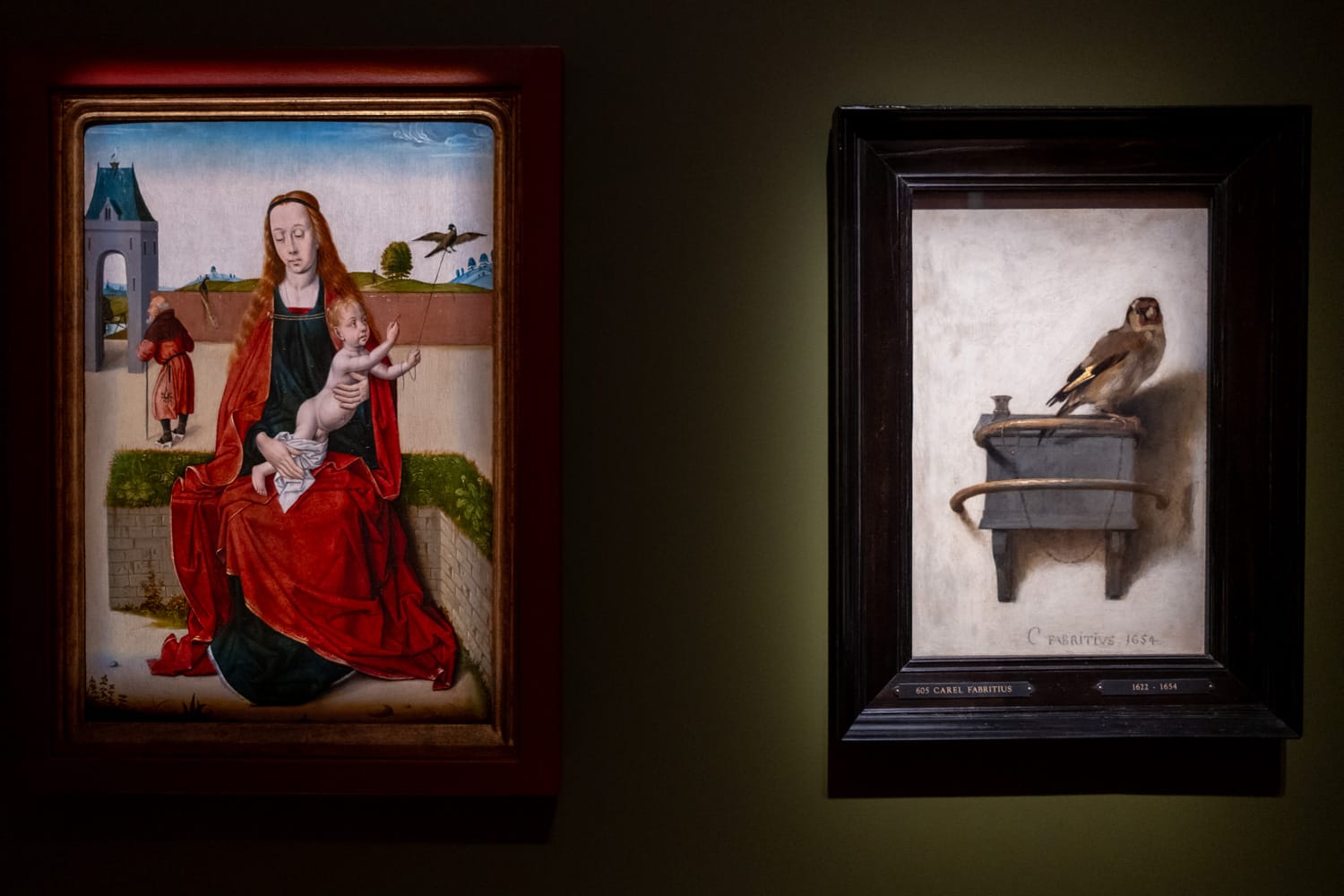
The exhibition is organized around seven thematic strands, from hunting and adornment to spiritual symbolism. At its philosophical core lies a provocative claim: humans covet what birds possess — flight, wings, freedom — and this envy has driven us to cage, kill, and consume them for millennia. Carel Fabritius's exquisite "The Goldfinch" (1654), a small trompe-l'oeil masterpiece, and one of several gems in the collection of the Mauritshuis, crystallizes this tension. The bird is rendered with breathtaking lifelikeness, yet a silver chain binds its leg — a pet prized for its song, stripped of its ability to take flight.
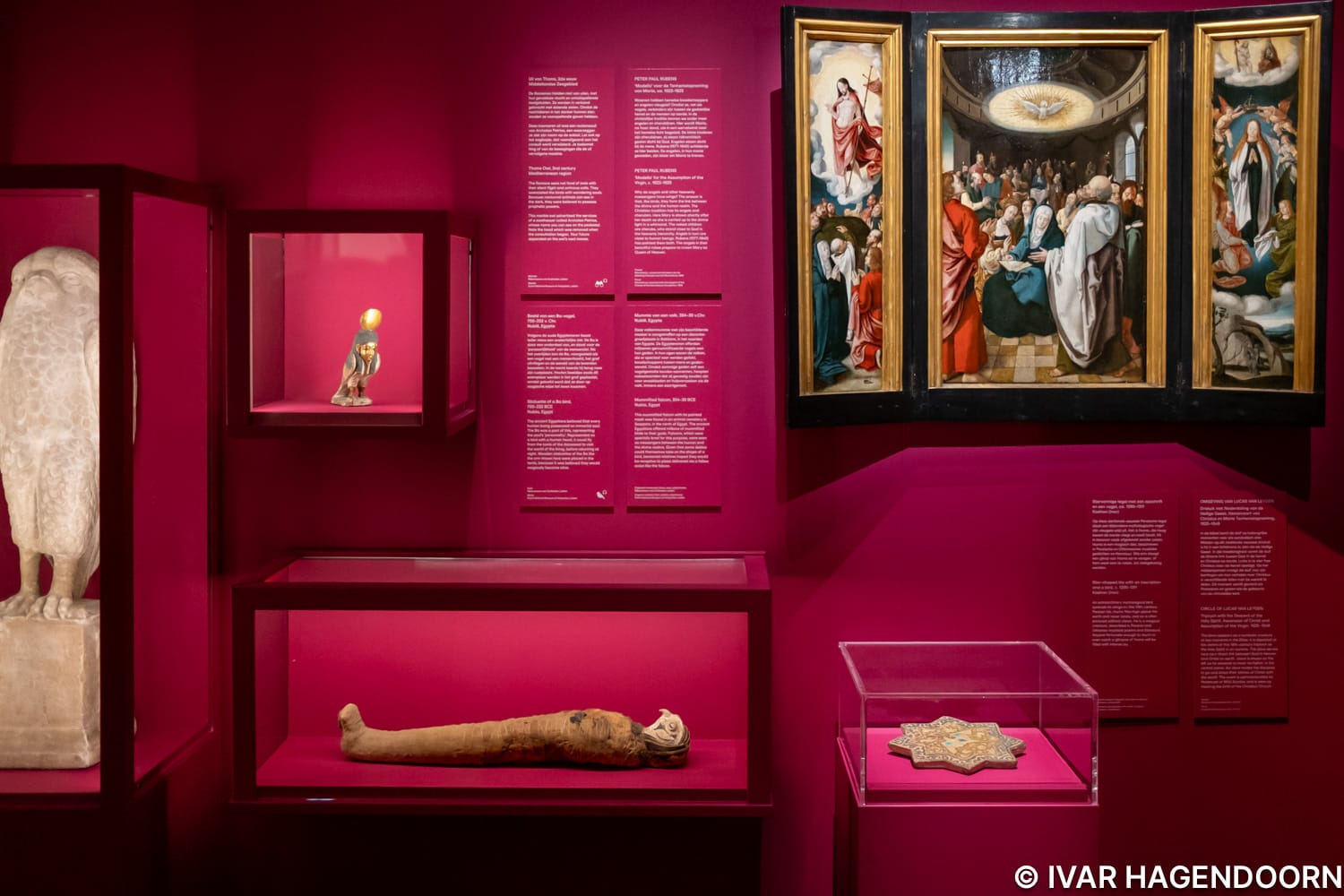
The range of works on show is impressive, from a cave-carved owl dating to 40,000–23,000 BC and an Egyptian falcon mummy to an ethereal feathered dress by Iris van Herpen from 2021. Rembrandt's unsettling "Still Life with Peacocks" (1639), with blood pooling vivid red beneath a slaughtered bird, defied the decorative conventions of its era. Nearby, Tamara Kostianovsky's "Big Vulture" (2016) made from discarded clothing dangles upside down from the ceiling, warning of collapsing vulture populations, due to poisoning by veterinary drugs used to treat livestock. These juxtapositions between old and new, beauty and brutality, give the exhibition a distinctive critical edge.
Critique threads through the show without ever hardening into didacticism. An excerpt from Nikolaus Geyrhalter's documentary Our Daily Bread shows hundreds of day-old chicks tumbling along industrial conveyor belts, while a drawing of a flamingo by famed naturalist John James Audubon underscores deeper contradictions in how we destroy what we rever. Unbeknownst to me Audubon observed the birds in their natural habitat and then killed one in order to be able to perfectly render it in drawing. Yet Schama resists moralizing, preferring to let visitors draw their own conclusions.
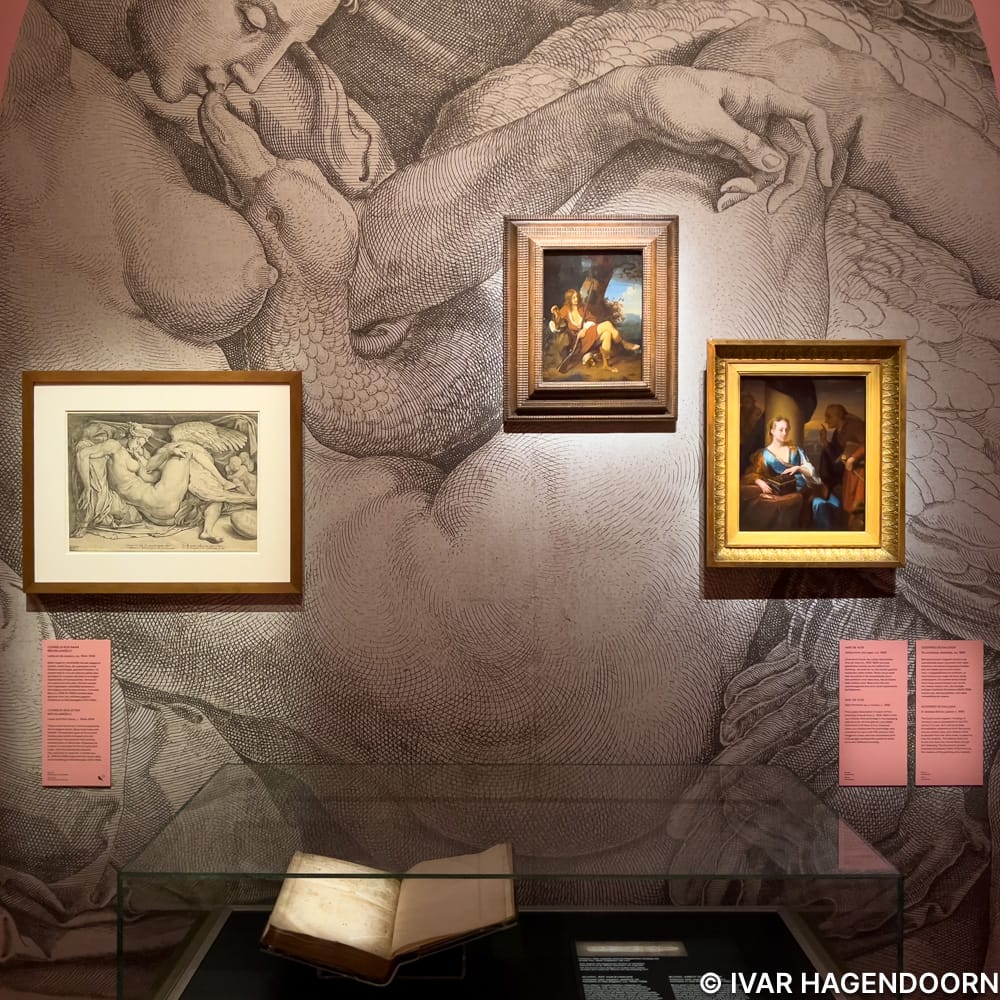
Despite the exhibition’s small size there is much to enjoy, from an impressive feather costume from Angola to Picasso's wonderful lithograph "La colombe" (1949) and two drawings by Leonardo da Vinci. Elsewhere, sexuality and symbolism intertwine: Godfried Schalcken's "The Useless Morals" (c. 1690) deploys a bird escaping its box as a thinly veiled metaphor, while an Egyptian Ba bird statuette and Christian doves testify to avian creatures as spiritual intermediaries across cultures.
The exhibition's architecture mirrors its argument. At one end, a "Madonna and Child", with the child holding a bird on a rope, by Dirk Bouts and Fabritius's "The Goldfinch" are shown against a projection of Jan Van IJken's video "The Art of Flying" (2015) capturing a mesmerizing murmuration of starlings. At the other stands Constantin Brancusi's "Bird in Space" (1932–1940), a polished brass sculpture distilling flight into pure abstraction, offering a counterpoint to Fabritius's chained songbird.
It probably doesn’t come as a surprise that I love Wunderkammers and I greatly enjoyed the exhibition. My sole criticism, and this is becoming something of a running theme whenever I write about art exhibitions in the Netherlands, is that it is too small. The same exhibition organized by the Louvre or the Petit Palais in Paris would have been at least four times as large, but unfortunately the Mauritshuis has only one room for temporary exhibitions. Even so, if you read all the texts and carefully study each artwork or artifact you can easily spend an hour or so at the exhibition. Of course, the permanent collection of the Mauritshuis is always worth visiting and if you look carefully you can find many more birds, caged, slaughtered or suspended in the air.
The exhibition is accompanied by an excellent catalogue, with essays by Simon Schama and Laura Cumming among others and reproductions of many works that didn’t make it into the show, and also includes an anthology of literary fragments about birds, selected by Schama, including Edgar Allan Poe’s The Raven and Bob Marley’s Three Little Birds.
BIRDS - Curated by The Goldfinch & Simon Schama is at the Mauritshuis in The Hague until 7 June 2026.