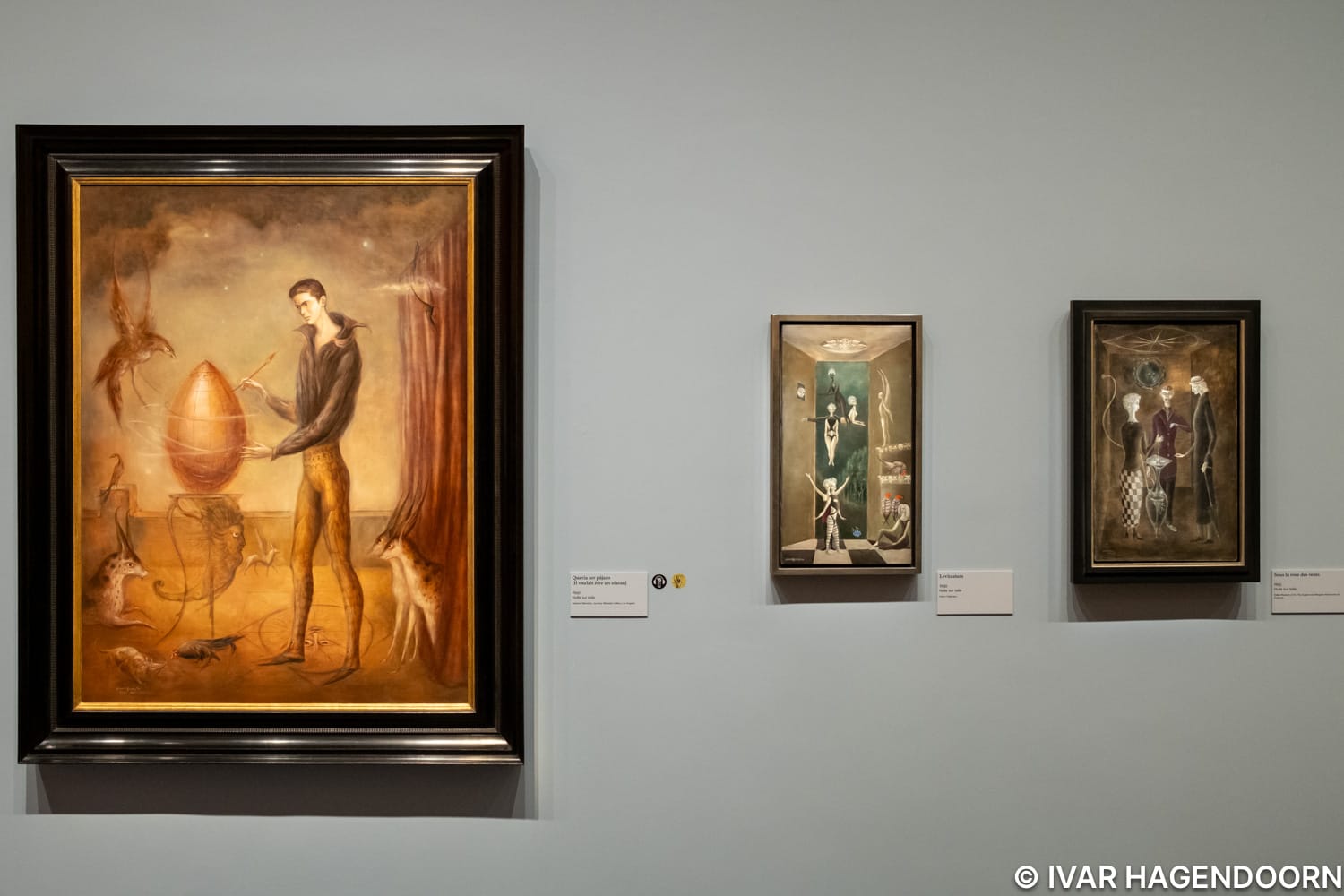
I first discovered the work of Leonora Carrington in 2024 at the Surrealism exhibition at the Centre Pompidou. I was delighted when I learned that the Musée du Luxembourg in Paris would organize a solo exhibition dedicated to her work. I was lucky to get in without a reservation. By the time I left a long queue had formed outside the entrance, and deservedly so: it is a small but wonderful exhibition.
Leonora Carrington (1917–2011) was long reduced to a footnote in Surrealism's history: the British artist who met Max Ernst in 1937 and followed him to France until war tore them apart. Yet such a sketch barely scratches the surface. She painted, drew, and wrote for more than half a century beyond that romance, and recognition has finally caught up with her — the 2022 Venice Biennale borrowed its title from one of her books, auction prices have soared, and her work has been included in multiple group shows. The Musée du Luxembourg's current exhibition, the first of its scale devoted to Carrington in France, gathers over a hundred works in a lucid presentation. Unfortunately, the organizers of the exhibition were unable to obtain “Les Distractions de Dagobert” (1945), Carrington’s magnum opus, which sold for USD 28.5 million at an auction in 2024 and which I would have loved to have seen in real life.
The exhibition unfolds in three sections and overturns persistent assumptions. The first revelation is the "Sisters of the Moon" watercolors, made when Carrington was only fifteen: a bestiary of witches, dragons, and demonic creatures that betrays an astonishing technical poise, a deep immersion in Symbolism and a profound familiarity with the work of Lewis Carroll, Jonathan Swift and Edgar Allan Poe. These images predate her formal encounter with Surrealism by several years, suggesting she was already a Surrealist without knowing it — a reminder that the movement grew as much from Symbolism and Expressionism as from Dada. The central section revisits her years with Max Ernst, including the Ardèche house they transformed together, before war shattered the idyll: Ernst was interned as a German national, while Carrington fled to Spain, where she suffered an emotional breakdown, was committed to a psychiatric hospital by her family, and eventually managed to escape via marriage to the Mexican diplomat Renato Leduc.
The exhibition's longest and most revisionist section follows her to Mexico City, where Carrington settled after separating from Leduc and marrying the photographer Chiki Weisz. There, alongside Remedios Varo, Alice Rahon, and Luis Buñuel, a second Surrealist enclave flourished — a chapter too often eclipsed by the New York exile. Did Surrealism really wither after the war? Carrington's output answers emphatically: no. Her early Mexican canvases conjure dreamlike, eroticized landscapes haunted by horses and women; from 1945 onward, her draftsmanship sharpened into a Mannerist precision reminiscent of Hieronymus Bosch, her palettes darkened, and her spaces filled with hybrid beasts whose meanings require fluency in occultism, astrology, and comparative religion. These works demand a patient, attentive gaze to unlock their secrets and are open to multiple interpretations.
The Musée du Luxembourg is housed in the former orangery of the Palais du Luxembourg, to the north of the Jardin du Luxembourg, near the Église Saint-Sulpice. In recent years I have seen some wonderful exhibitions at the Musée du Luxembourg. If you’re visiting Paris I highly recommend adding it to your itinerary.
Leonora Carrington is at the Musée du Luxembourg in Paris until 19 July 2026.
Related Posts
Pierre Soulages: Works on Paper at the Musée du Luxembourg.
Gertrude Stein and Pablo Picasso at the Musée du Luxembourg.