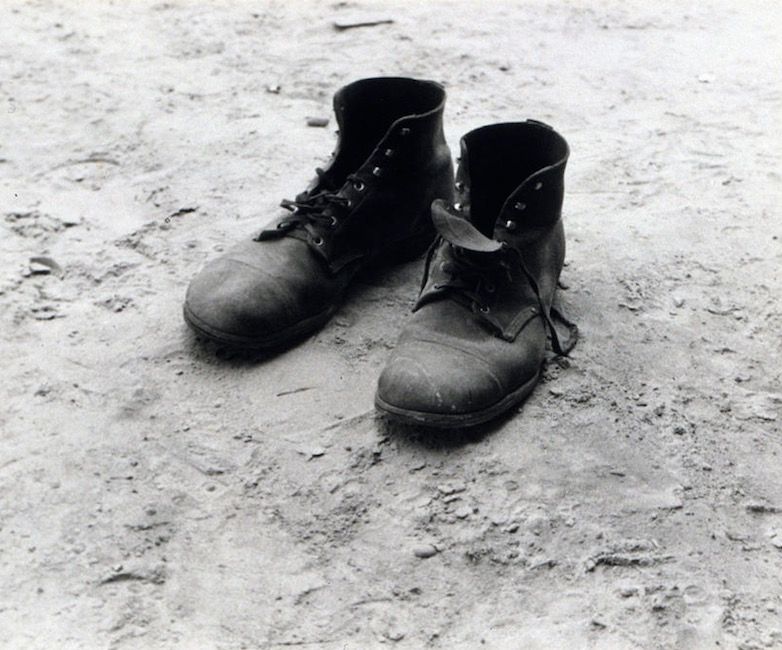
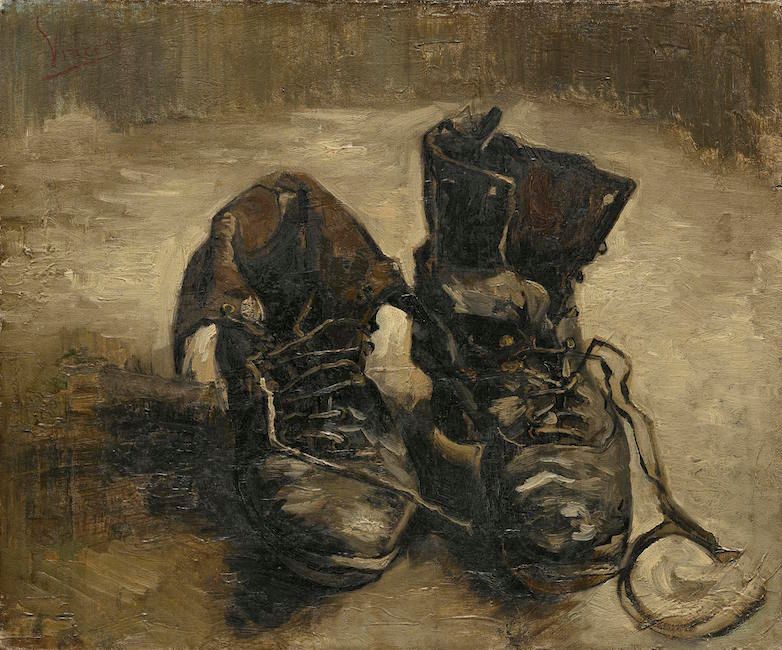
Left: Walker Evans, Floyd Burroughs' Boots (1936); Right: Vincent van Gogh, Shoes (1886)
While looking for more work by Walker Evans I came across this photograph of Floyd Burroughs' boots. It reminded me of Vincent van Gogh's Schoenen/Shoes (1886).
Walker Evans was born in 1903 into an affluent family in St. Louis, Missouri. He went to Williams College, a liberal arts college in Williamstown, Massachusetts, to study French literature but dropped out after a year. In 1926 he spent a year in Paris, where he took classes at the Sorbonne and rubbed shoulders with writers and artists. I'd wager Walker Evans was familiar with Vincent van Gogh's painting. He may have seen it at an exhibition or in a catalogue. Evans returned to New York to become a writer, but drifted into photography.
Vincent van Gogh's Shoes are probably the most famous shoes in philosophy and art history. Martin Heidegger saw the painting at an exhibition in Amsterdam in 1930 and would refer to it in a key passage in The Origin of the Work of Art (1935). Heidegger took to the shoes to be those of a peasant woman. In The Still Life as a Personal Object (1968), the art historian Meyer Schapiro took issue with Heidegger's description, arguing that the shoes were not those of a peasant woman but had belonged to Van Gogh himself. Heidegger's and Schapiro's appropriations of Vincent van Gogh's shoes are the point of departure for Jacques Derrida's meticulous reading of Heidegger in his essay Restitutions de la vérité en pointure (Restitutions of the Truth in Pointing) (1978), which has itself become the topic of several essays.
The Origin of the Work of Art remains, or perhaps I should say once was, one of my favourite texts by Martin Heidegger. I should revisit it some time.