The Rijksmuseum in Amsterdam has organized an ambitious exhibition devoted to Ovid's Metamorphoses, assembling roughly eighty exceptional works from fifty institutions worldwide. Partnering with Rome's Galleria Borghese — where the show will travel in late June — the exhibition presents an extraordinary roster of artists: Caravaggio, Bernini, Titian, Michelangelo, Rubens, Poussin, Rodin, Magritte, and Louise Bourgeois, among many others. Across ten thematic rooms, the exhibition traces the unrelenting influence of Ovid's ancient poem on two millennia of visual culture.
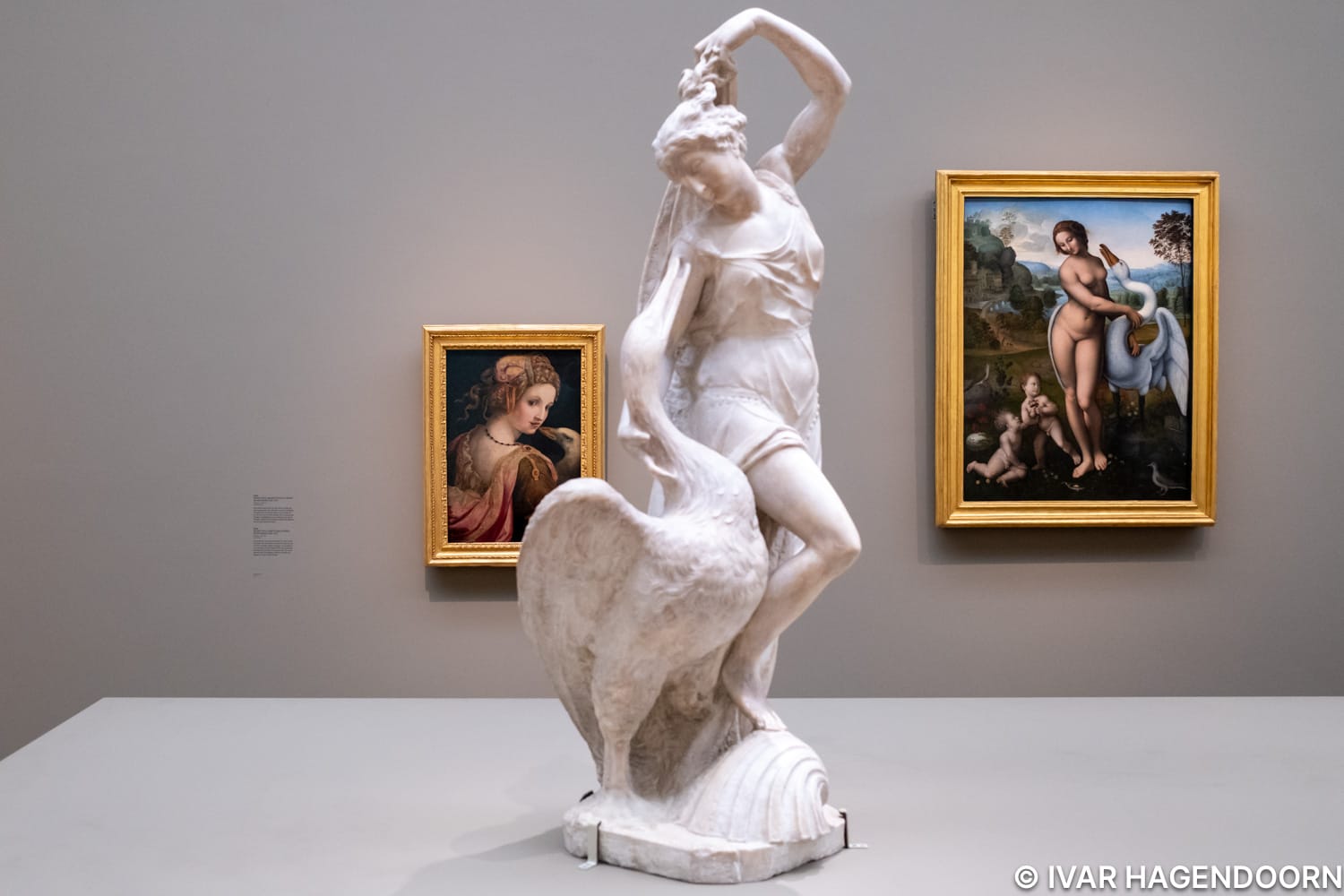
The curatorial selection foregrounds the myths most fervently revisited across centuries — the creation, Danaë's golden rain, Leda's entanglement with the swan, Arachne and Narcissus's fatal self-regard. What elevates the presentation beyond a conventional survey is its insistence on juxtaposition: Correggio's languorous Danaë hangs in dialogue with Titian's stormier rendition; a medieval Flemish tapestry depicting a velvet-cloaked Narcissus, his name emblazoned on his thigh like a modern brand logo, competes with Caravaggio's chiaroscuro close-up. Pygmalion and Galatea likewise command attention: Jean-Léon Gérôme's classic rendition, on loan from New York’s Metropolitan Museum of Art and Rodin's nonfinito liberation of the beloved from marble are presented next to Paul Delvaux's 1939 inversion of the myth, in which a nude woman falls for a stone boy. Such pairings reveal not only the malleability of each myth but also demonstrate how each era reshapes Ovid's raw material to suit its own obsessions.
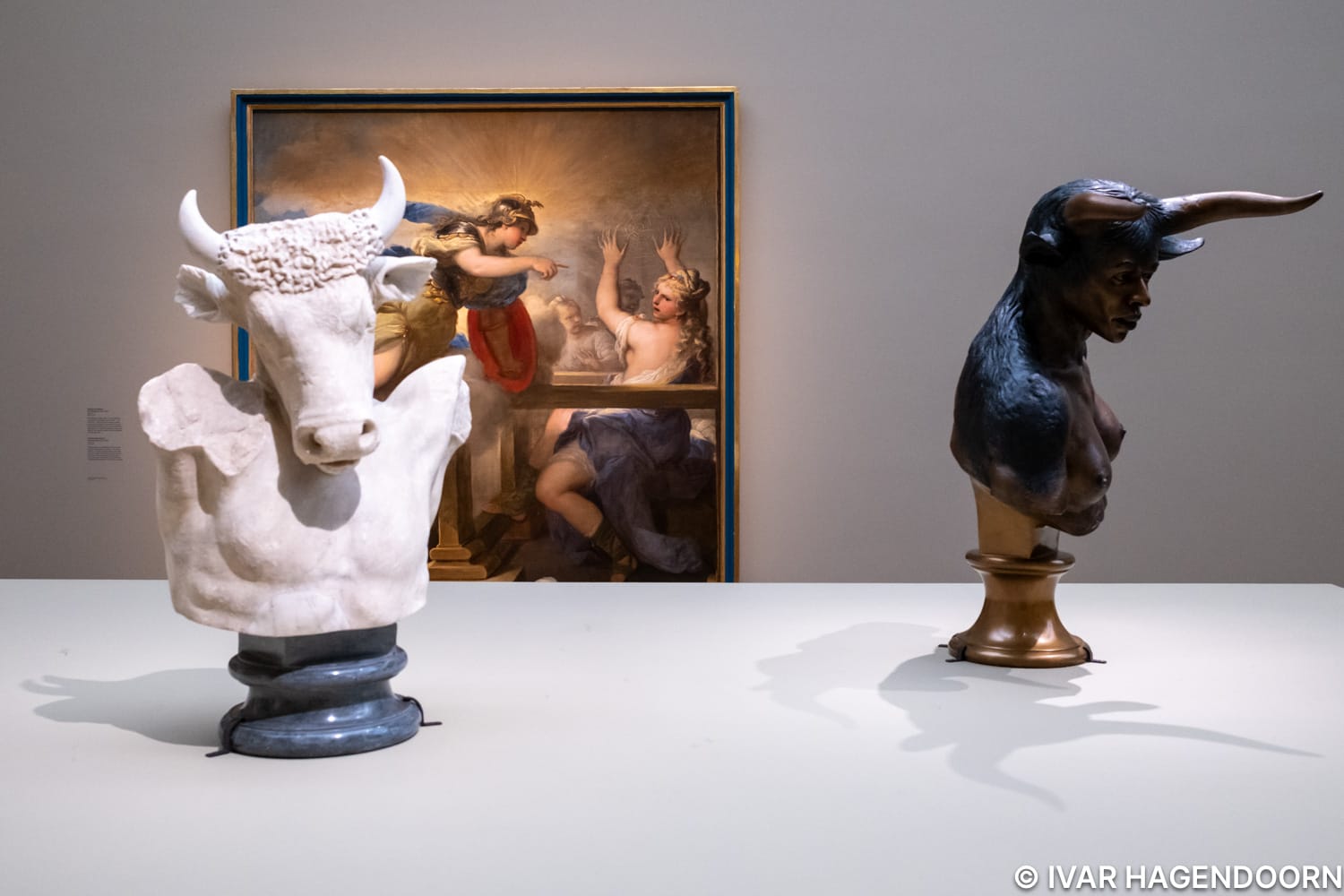
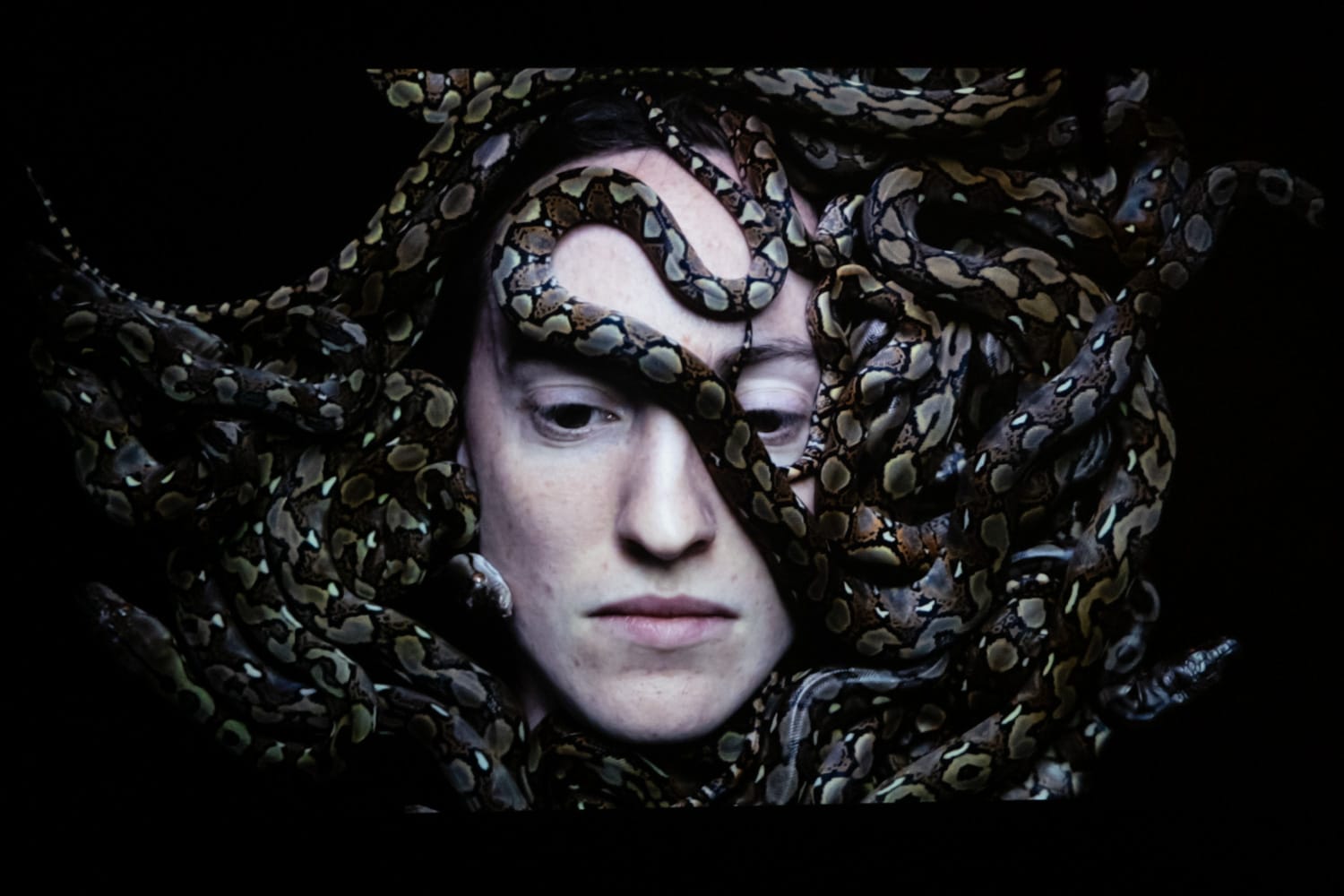
Several rooms foreground the poem's darker currents — divine caprice, punishment, and sexual violence. Tintoretto's Arachne, condemned by Athena to spin as a spider for the audacity of weaving better than a goddess, stands alongside Bourgeois's colossal bronze arachnids. Medusa, that paradigmatic victim-turned-monster, receives treatments ranging from Gaetano Guidi's empathetic bronze to Juul Kraijer's hypnotic video triptych of live serpents gliding across a woman’s serene face. The curators acknowledge the uncomfortable truth embedded in these narratives: Ovid's world teems with coercion, and centuries of artists frequently aestheticized sexual violence into sumptuous idylls, reinforcing a pervasive male gaze.
The curators might be faulted for the near-total omission of medieval works — the story now leaps rather abruptly from antiquity to the Renaissance — with only two objects representing the thousand years between 500 and 1500. Yet those rare inclusions, a thousand-year-old elk antler carved into an ornamental shield at Metz Cathedral and a wormy linden trunk sprouting wooden spoons, prove how deeply Ovid’s myths permeated pre-Renaissance consciousness.
Toward the end the exhibition loses some of its momentum. A series of self-portraits taken at different stages of his life by Roman Opalka shows his face gradually aging, which is only tangentially related to Ovid’s Metamorphoses (Ovid’s "Ages of Mankind" refers to an altogether different notion). Apart from that the concept is by now all too familiar with dozens of YouTube videos based on the same idea. And while I enjoyed seeing several works by Arcimboldo their inclusion only bears a passing relation to the theme of Ovid’s Metamorphoses.
In the exhibition’s final room Luca Giordano's gruesome painting of Apollo flaying the skin of the satyr Marsyas, after the latter lost a musical contest with the leader of the Muses, is paired with Magritte's "Le modèle rouge III", in which leather boots imperceptibly transmute into living flesh, the leather of course once having been living flesh as well.
Metamorphoses is one of the best exhibitions at the Rijksmuseum in years on par with 2019's Dutch and Spanish masters exhibition. I thoroughly enjoyed last year’s American Photography exhibition, but I was a bit puzzled why it was on show at the Rijksmuseum. My sole criticism is that the exhibition could have been larger still, its size constrained by the two wings reserved for temporary exhibitions at the Rijksmuseum.
Ovid's conviction that all matter transforms yet nothing perishes finds its most persuasive proof not in philosophical argument but in the sheer accumulative evidence of this exhibition: centuries of artists transmuting pigment, stone, bronze, and bone into vessels for human passion, terror, and wonder. Ovid's epic poem was never merely a compendium of myths but an inexhaustible engine of artistic empowerment — a catalyst compelling each generation to wrestle anew with chaos, desire, brutality, and transcendence.
Metamorphoses is at the Rijksmuseum in Amsterdam until 25 May 2026. It will travel on to the Galleria Borghese in Rome where it will be on show from 22 June to 20 September 2026.