The Pinault Collection's latest exhibition, Clair-obscur, assembles roughly one hundred works by 27 artists that meditate on the darkness of our present time. The exhibition takes its cue from an essay by the Italian philosopher Giorgio Agamben in which he seeks to define the contemporary. “The contemporary”, according to Agamben and with a nod to Nietzsche’s Untimely Meditations, “is he who firmly holds his gaze on his own time so as to perceive not its light, but rather its darkness. All eras, for those who experience contemporariness, are obscure. The contemporary is precisely the person who knows how to see this obscurity, who is able to write by dipping his pen in the obscurity of the present.” The show tackles this somber subject with admirable breadth, and its reach back into the interwar period lends the reflections a darker historical weight, especially resonant in our present age of ruin.
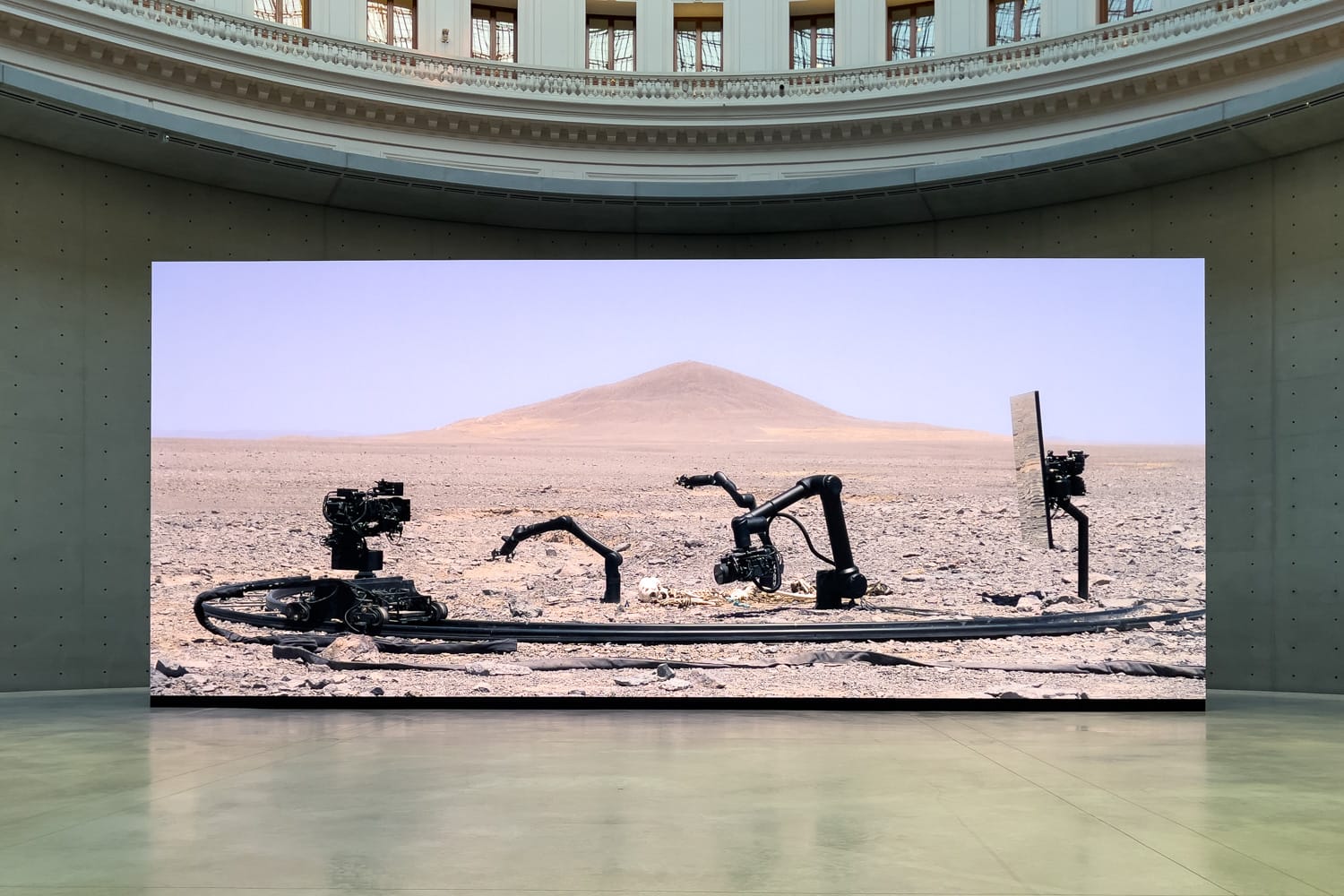
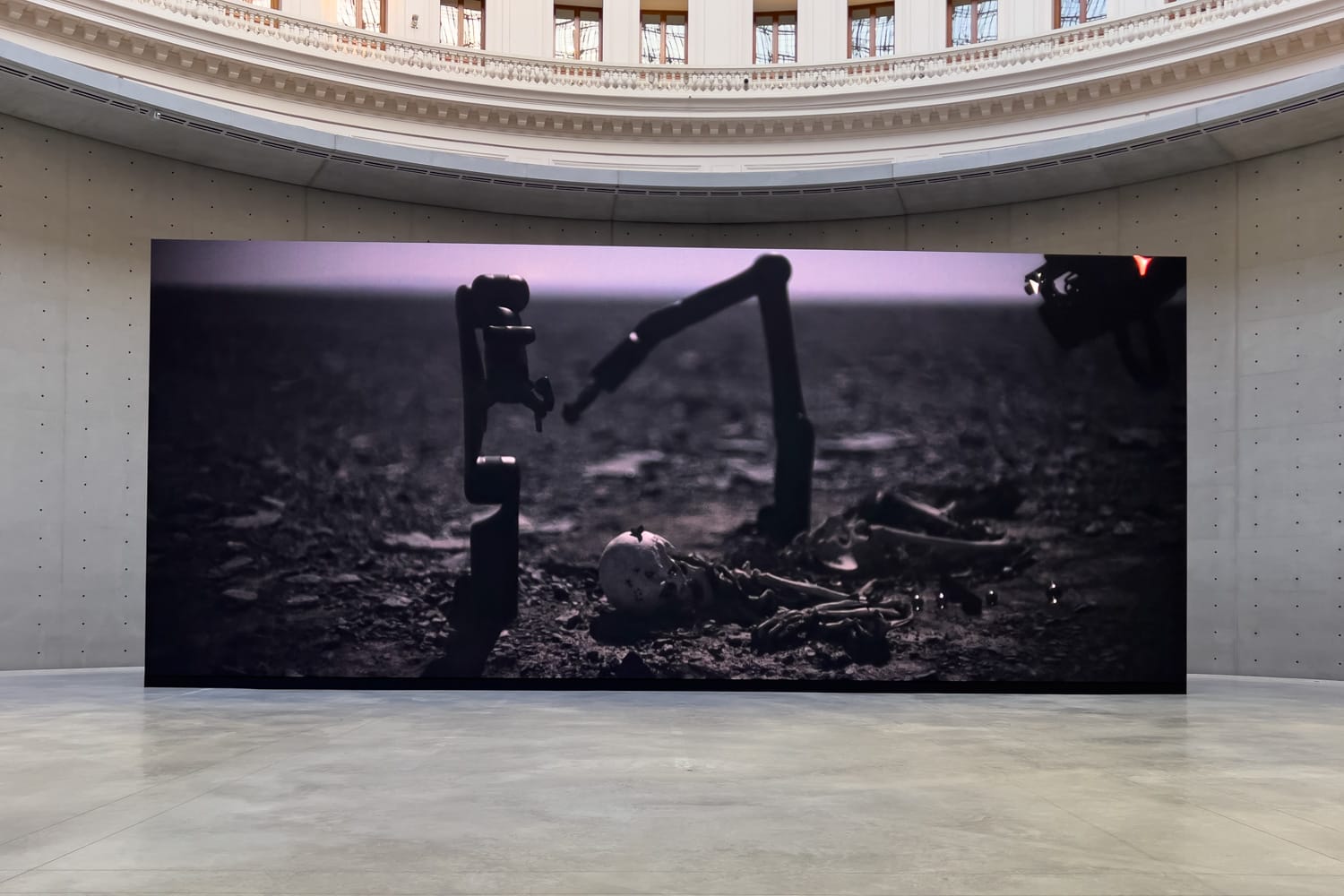
I greatly enjoyed seeing Pierre Huyghe's monumental film "Camata" again, which was one of the highlights of Liminal, his solo show at the Punta della Dogana during the 2024 Venice Biennale and which now occupies the heart of the Bourse de Commerce's rotunda. Shot in Chile's Atacama Desert, it shows a couple of robot arms slowly probing a human skeleton. It is a contemporary vanitas suspended between archaic ritual and science fiction. I was once again completely mesmerized. I stayed past closing time until the guards kindly requested me to leave. I got the impression that it is a different edit, but I could be mistaken. My sole criticism is that it doesn’t use the architecture of the rotunda, like some previous installations.
From this striking overture, the exhibition unfolds with unusual historical depth, unveiling pieces long kept from public view. Yves Tanguy receives a welcome tribute through desolate dreamscapes from the late 1920s that feel like precursors to Huyghe's film. A subsequent gallery braids together Jean Dubuffet's awkwardly painted grotesque figures, Alberto Giacometti's attenuated sculptures and Germaine Richier's tortured bronzes, with Maria Martins' skeletal bird "Black Fog" presiding at the center. Nearby, black ink paintings by Louis Soutter converse with Carol Rama's "bricolages" and Bruce Conner's debris assemblages, while Bruce Nauman's severed-head fountain deepens the register of unease. What unites these disparate works is economy of means—a spare directness that drives straight to expression.
Not every piece earns that intensity. Danh Vo’s antique-and-modern designer assemblages look cool but lack substance. In "Fire Woman" Bill Viola once again tried too hard to reach for the sublime and the result is as bombastic as ever.
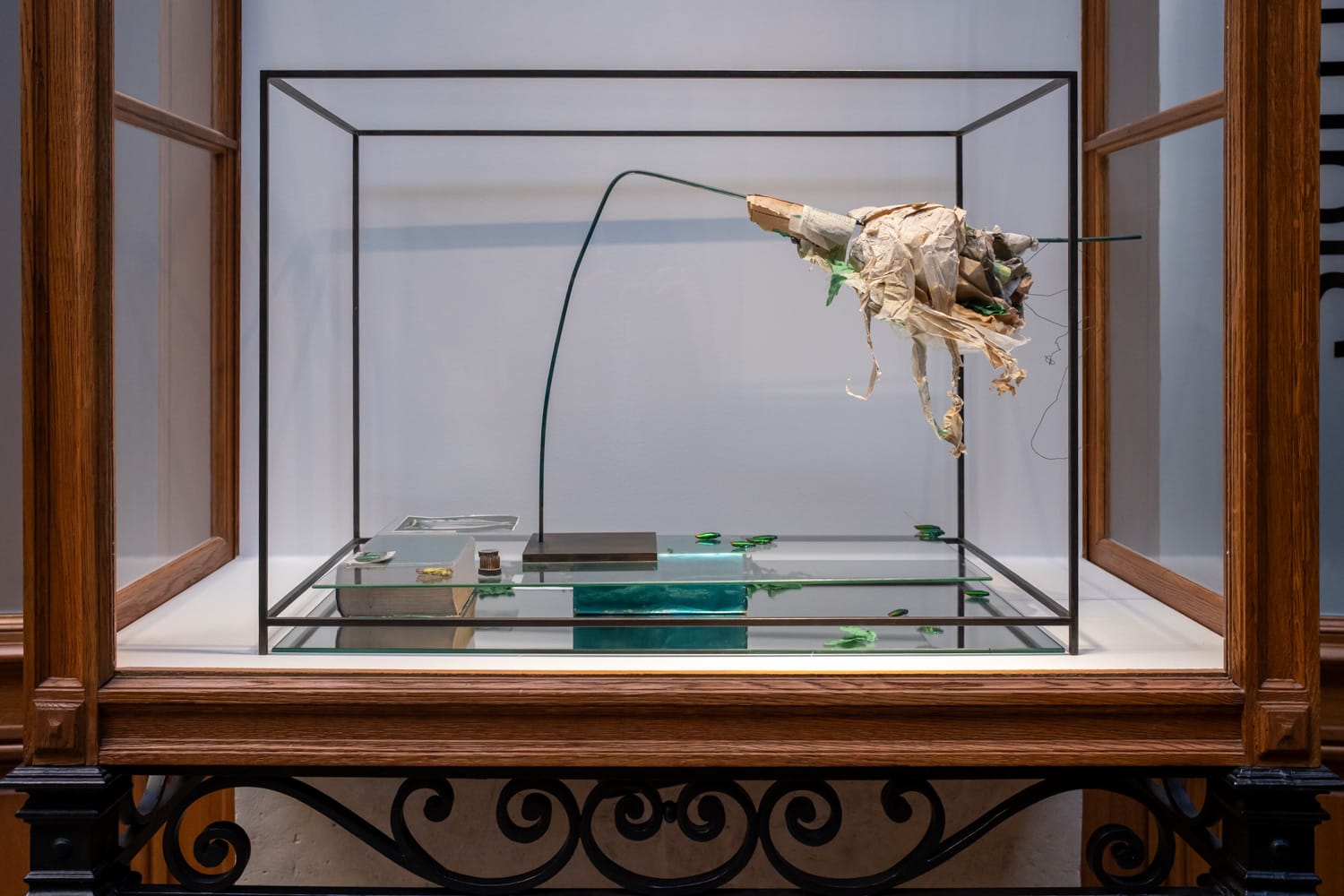
The true marriage of thought and form surfaces in Sigmar Polke. His reimagining of a Dürer drawing for Emperor Maximilian I’s prayer book trembles on the edge of erasure, while the nine vast semi-translucent canvases of "Axial Age", which were last exhibited at Anne Imhof’s Natures Mortes at the Palais de Tokyo, remind us that even masterpieces are fragile and bound, like all else, to vanish. "Axial Age" and "Camata" alone make this show well worth a visit. I also greatly enjoyed the installations by Laura Lamiel that occupy the display cases that surround the rotunda and which many visitors walked by without looking.
Clair-obscur is at the Bourse de commerce-Collection Pinault, in Paris until 31 August 2026.