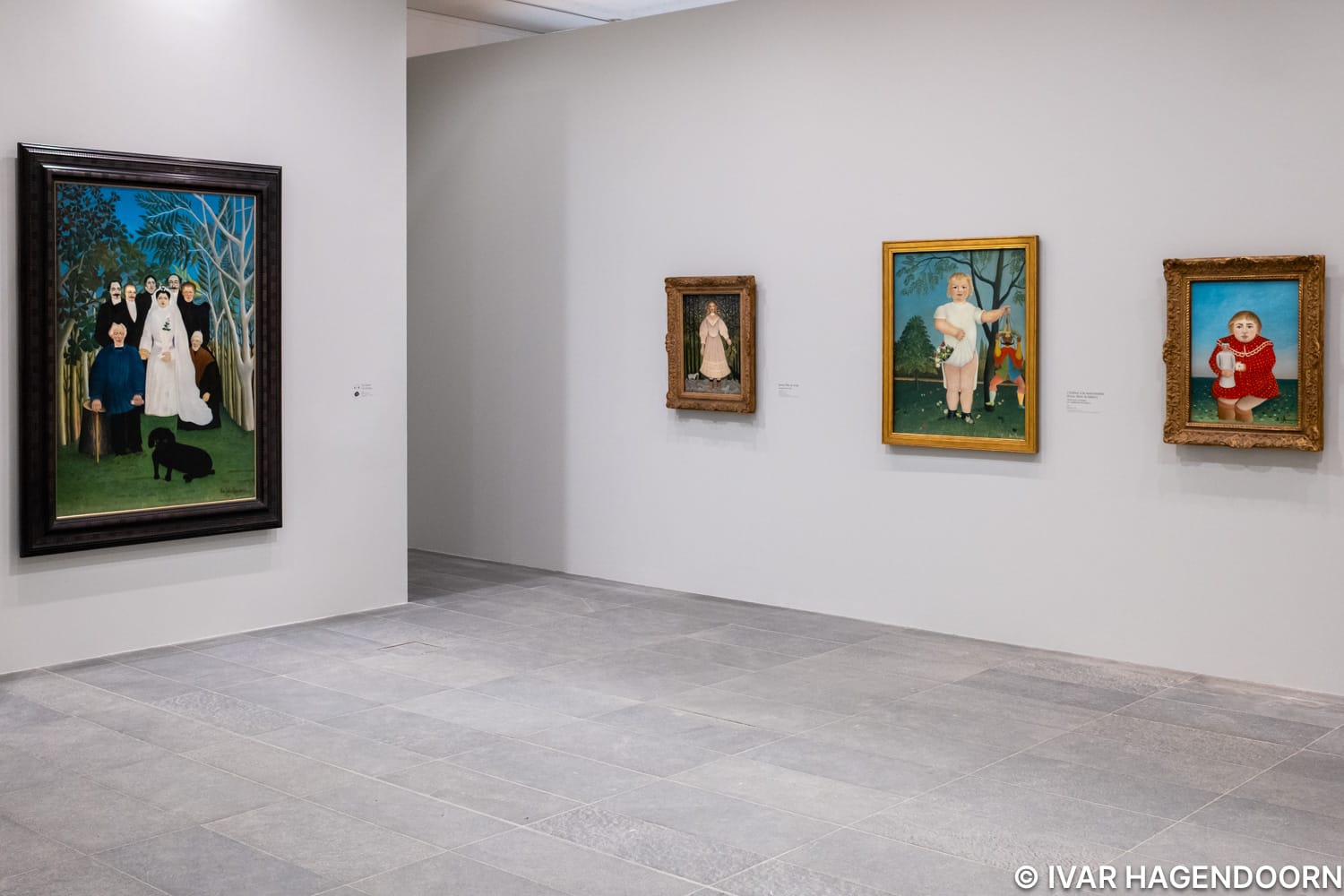
Henri Rousseau couldn’t paint, his human and animal figures look awkward and his exotic jungle scenes are completely over the top, but that is precisely what makes his work so charming. As a large retrospective at the Musée de l’Orangerie in Paris, “Henri Rousseau: The Ambition of Painting”, makes clear, Rousseau was not the naïve painter that he is often made out to be. He worked rigorously and constantly sought to perfect his distinctive style. His early admirers already knew this, Guillaume Apollinaire, Pablo Picasso, and Robert Delaunay championed him during his lifetime, and after his death the Dadaists and Surrealists, Tristan Tzara and André Breton among them, carried his reputation forward.
I had been eager to see the exhibition. I am, of course, familiar with the work of Henri Rousseau, which hangs in every major museum of modern art, but this was my first chance to see an overview of his entire body of work. The Musée de l’Orangerie houses the collection of Paul Guillaume, Rousseau's chief interwar dealer, and was able to secure a number of exceptional loans from other institutions, most notably the Barnes Foundation in Philadelphia, whose founder Albert Barnes once owned some fifty works by Henri Rousseau. There are also loans from MoMA, the Metropolitan Museum of Art, the Guggenheim, the Art Institute of Chicago, and the Beyeler Foundation. The result is an exhibition of unprecedented scope bringing together the "Sleeping Gypsy" (1897), the "Snake Charmer" (1907), “The War” (1894), “Child with Puppet” (1892) and several of his jungle paintings.
Henri Rousseau didn't have any formal training in art. For years he worked as a toll collector on the outskirts of Paris, earning him the nickname "le Douanier". He only took up painting when he was in his early forties. At the age of 49, he retired from his job to fully dedicate himself to art.
Rousseau's output falls into two registers. The first comprises modest landscapes, still lifes, and portraits—intimate canvases he sold cheaply to neighbors and which were later reclaimed by critics and dealers as his fame grew. Resistant to the prevailing current of Impressionism, he devised what he called a realist style, though it was far removed from anything that was considered realist at the time. In a style reminiscent of early renaissance paintings he carefully drew every single leaf. Continuous outlines bound every form; foliage, waves, and clouds acquire an unreal sharpness that paradoxically intensifies their presence. The perspective is flattened, which, presumably is what caught the eye of Matisse and Picasso.
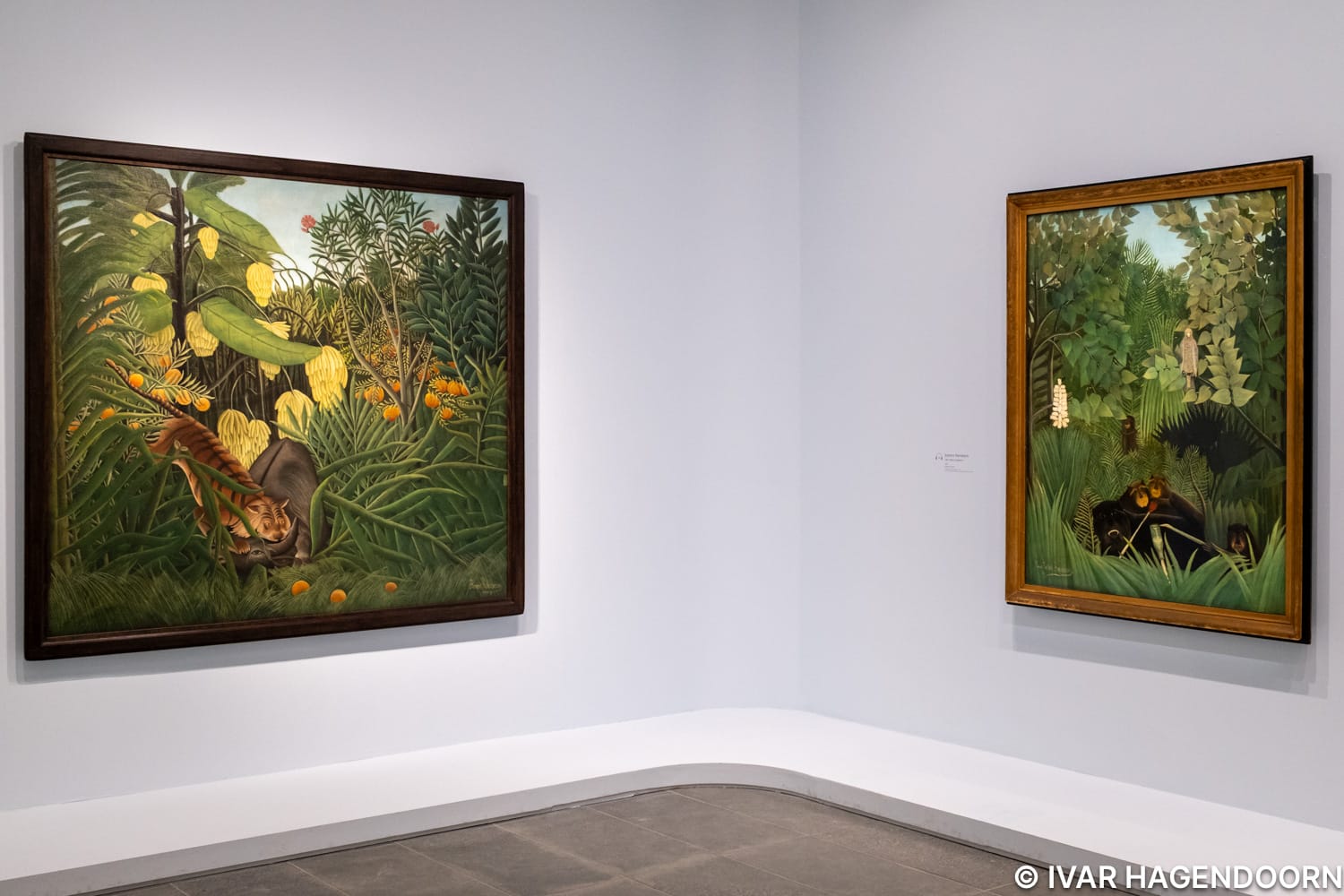
His second register—the monumental jungle scenes and allegories he submitted to the Salon des Indépendants and in vain offered to official institutions—reveals the fullest scope of his ambition. Here the same precise drawing and flat color give way to chromatic invention, particularly in greens that he modulates inexhaustibly, sharpened by sudden pinks and reds. Botanical fidelity hardly matters. His contemporaries believed that he had traveled to Mexico as part of his military service, but as he confessed in the only interview he gave during his life, he never left France and his jungle paintings were all inspired by his visits to the Jardin des Plantes, Paris’s botanical gardens, and the nearby Natural History Museum. Canvases such as "The Hungry Lion Throws Itself on the Antelope" (1905) and "Fight Between a Tiger and a Buffalo" (1908) display this palette at its richest.
Needless to say that I enjoyed the exhibition much more than I had expected. My personal favorites are "A Carnival Evening" (1886), "Rendezvous in the Forest" (1889), “Child with Puppet” (1892) and "The Merry Jesters" (1906).
Henri Rousseau. L’ambition de la peinture is at the Musée de l’Orangerie in Paris until 20 July 2026.
Links
Dans le flou at the Musée de l’Orangerie.
Robert Ryman. The Act of Looking at the Musée de l’Orangerie.
Matisse at the Musée de l’Orangerie.
Masterpieces from the Museum Berggruen at the Musée de l’Orangerie.