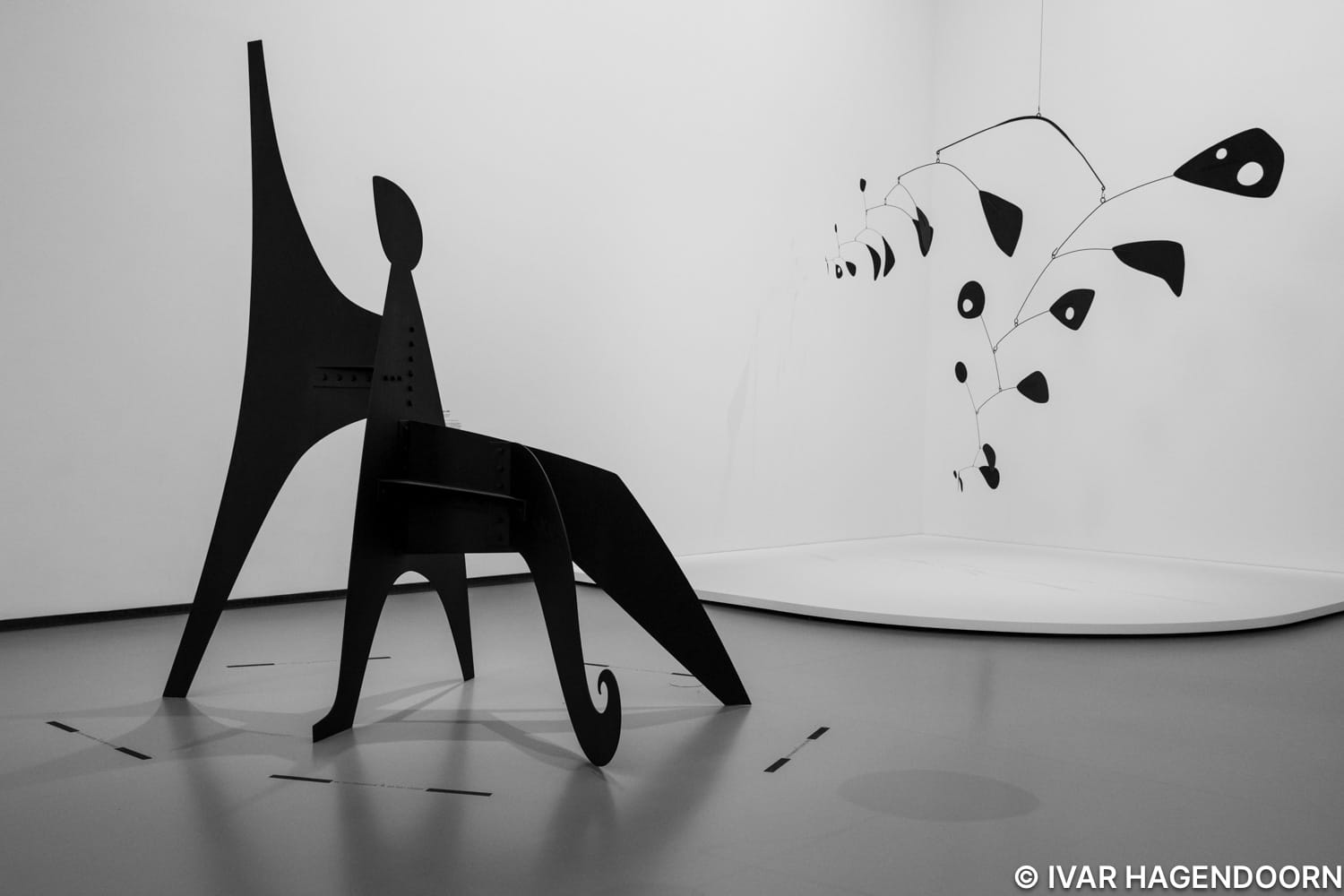
The Fondation Louis Vuitton has handed Paris a gift. The exhibition “Calder. Rêver en Équilibre” (Calder. Dreaming in Balance) marks a twin anniversary — the sculptor's arrival in the city in 1926 and his death fifty years later — and it claims every floor of Frank Gehry's building as well as the rear lawns, where two late sculptures, the jagged "Black Flag" (1974) and the curving crimson "Five Swords" (1976) have been installed. More than 300 works trace a roughly chronological arc. From the lobby, where a large mobile, "Triumphant Red" (1963), is suspended in mid-air, Gehry's architecture seems almost to have been built for Calder: both share a lightness and a sense of movement.
Back in 2021 I visited an Alexander Calder exhibition at the Neue Nationalgalerie in Berlin, Minimal/Maximal, which concentrated on the works for which Calder is best known. With that show still fresh in my mind, the Fondation Louis Vuitton exhibition had not ranked high on my agenda. How wrong I was! Calder's mobiles are always a delight to behold, and if you think you know his work, you may be in for a surprise — I certainly was.
The story begins where Alexander Calder's did. Born in Philadelphia in 1898 into a family of sculptors and a Sorbonne-trained painter mother, he trained first as a mechanical engineer, then turned to painting in the socially conscious style of the Ashcan School. That Calder originally trained as a painter didn’t come as a surprise to me — many artists do — that he would return to painting throughout his career was new to me.
In 1926 Calder moved to Paris where he would remain until 1933. While an art student he had become fascinated by the circus. Out of that fascination grew the "Cirque Calder" (1926–1931), a miniature world of wire performers that eventually filled five suitcases — sword swallowers, acrobats, a lassoing cowboy — which the artist animated himself in performances lasting up to two hours. On loan from the Whitney Museum in New York, this fragile marvel, which makes up about half of the downstairs gallery of the Fondation Louis Vuitton, was a joy to behold and one of the exhibition's biggest surprises.
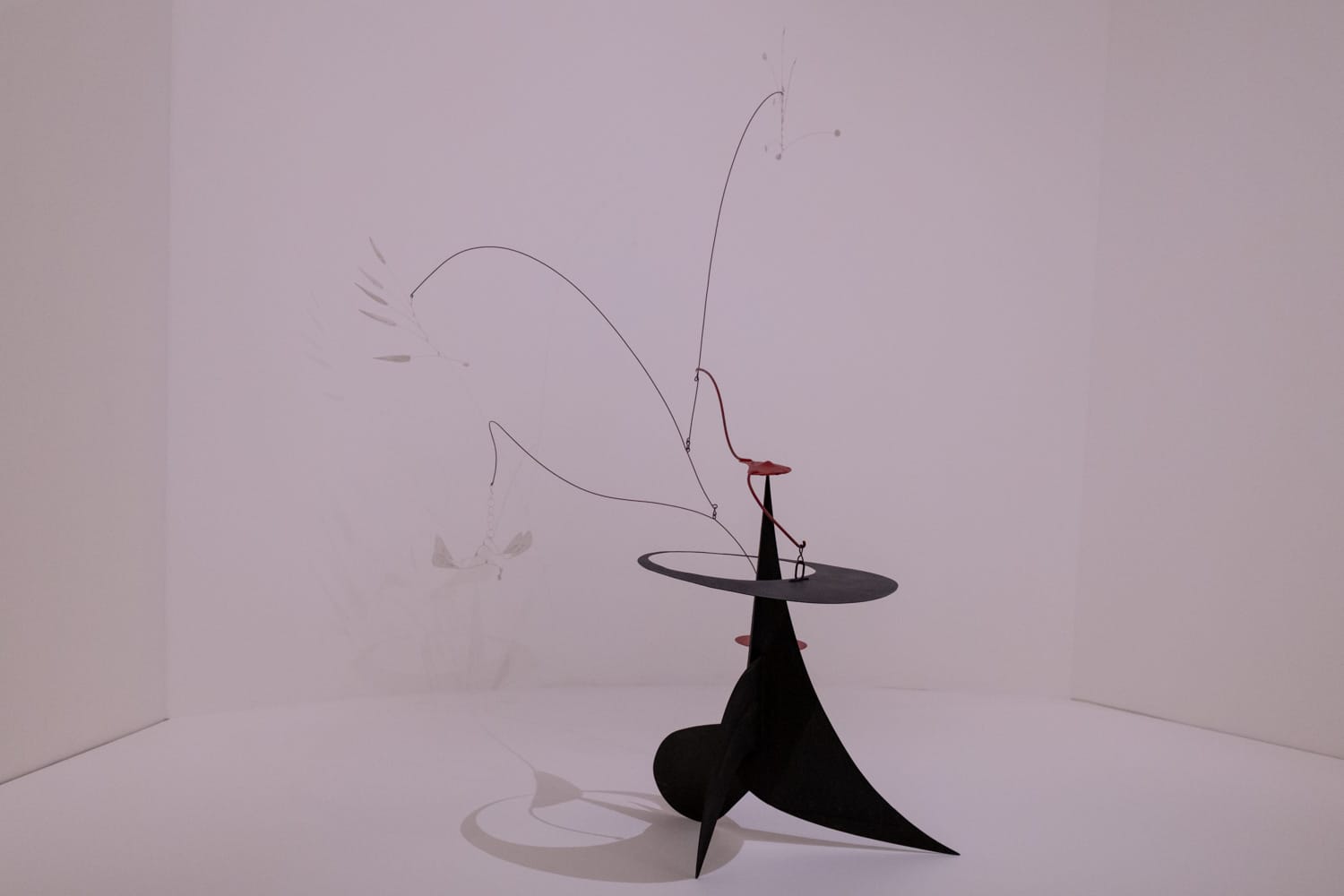
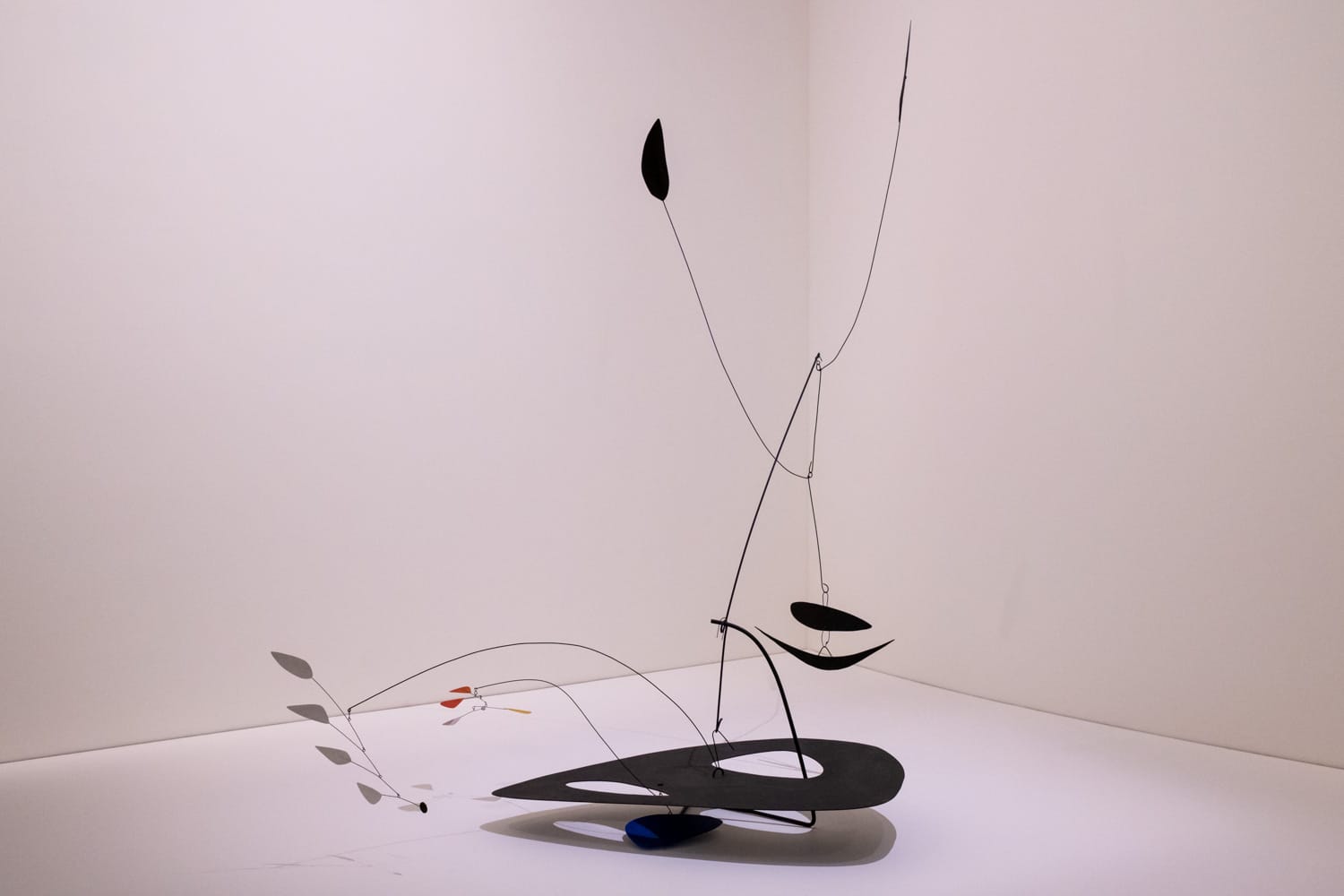
Then came the leap. Calder's wire portraits of Montparnasse luminaries like Josephine Baker introduced something new: drawing in space, with cast shadows doubling each figure on the wall behind it. A 1930 visit to Piet Mondrian's Paris studio, its walls papered with planes of primary color, came as a shock to Calder. For two weeks he returned to painting, creating some abstract canvases, which are not at all bad, but he soon realized that what he really wanted to do was to create the same kind of abstraction with wires and metal. Out of this came the suspended forms, which Marcel Duchamp later named "mobiles", and the fixed sculptures, which Jean Arp subsequently dubbed “stabiles". The curators have brought together an amazing collection of mobiles in different sizes, which made me wonder whether there are any left in other museums.
Alexander Calder was a master craftsman and for years he designed and crafted jewelry for his wife and friends and family. I’m not really into jewelry, but some of these pieces are pretty stunning and would put many jewelry designers to shame and then to know that he created them as a mere pastime.
The upper floors gather his astonishing range — fish scaled in colored glass and the wartime "Constellation" series fashioned from painted wood when steel grew scarce — before the monumental and final pieces crown the top floor. Some mobiles rest on the floor, others are suspended from the ceiling, stirred to life by the currents of air caused by visitors walking by.
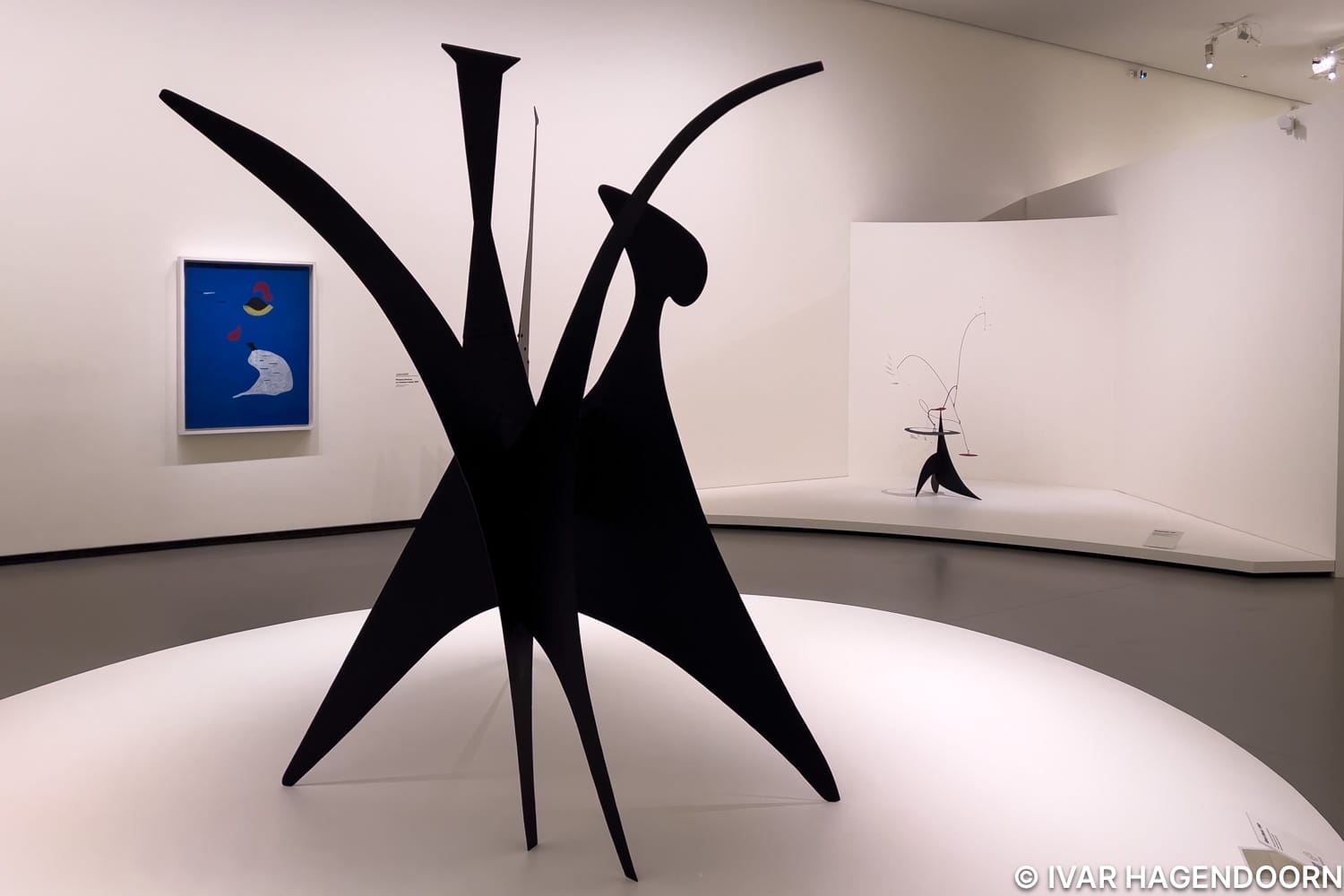
“Calder. Rêver en Équilibre” is a glorious celebration of an artist who never stopped creating. It is also one of those exhibitions that only the Fondation Louis Vuitton could mount. To set Calder's work in context, the curators have assembled a selection of masterpieces by Kandinsky, Mondrian, Miró, Léger and Picasso, which by itself would make for an excellent exhibition.
I normally visit the Fondation Louis Vuitton on a Saturday morning, making sure to be the first in line, which usually means arriving half an hour in advance. This time I visited on a Friday evening. To my surprise it was relatively quiet and the last hour or so before the museum closed I had the galleries almost all to myself. The perfectly air-conditioned spaces also served as a refuge from the sweltering heat outside.
Calder. Rêver en Équilibre is at the Fondation Louis Vuitton in Paris until 16 August 2026.
Related Posts
Alexander Calder. Minimal/Maximal at the Neue Nationalgalerie in Berlin.
Gerhard Richter at the Fondation Louis Vuitton.