With Liminal, Pierre Huyghe’s solo exhibition at the Punta della Dogana during the 2024 Venice Biennale, still fresh on my mind I was eager to see the exhibition he had conceived for the Fondation Beyeler. Unfortunately, it was a bit of a let down. Some rooms had been deliberately left empty, another room contained little more than a small robotic worm. A key difference between the exhibition at the Punta della Dogana and the one at the Fondation Beyeler is that the former was shrouded in darkness, creating a sense of mystery. With the lights on you immediately notice that there is nothing to see and move on to the next room.
At the heart of the exhibition sits “Apnea” (2026), a newly commissioned work conceived especially for the Fondation Beyeler. It consists of a liquid-filled vitrine containing a robotically animated silicone form that swells and subsides in a human cadence as if it were breathing. Its respiration saturates the exhibition rooms. Air sighs from small perforations in the walls, and the glass panes dividing some of the galleries fog opaque or clear to transparency in time with each breath. While this sounds interesting on paper it failed to captivate me.
Having said that, I greatly enjoyed seeing “Human Mask” (2014) and “Camata” (2024) again. “Human Mask” (2014) was filmed in a derelict Japanese café that was shut down following the 2011 earthquake, tsunami, and Fukushima nuclear disaster. A figure in a white Noh-like girl's mask and long black wig drifts through the café while a tinny female voice broadcasts warnings across the exclusion zone. Fur betrays the illusion: the figure is Fuku-chan, a monkey once employed serving customers in a Tokyo sake bar, and his actions and gestures make the scenery look all the more desolate.
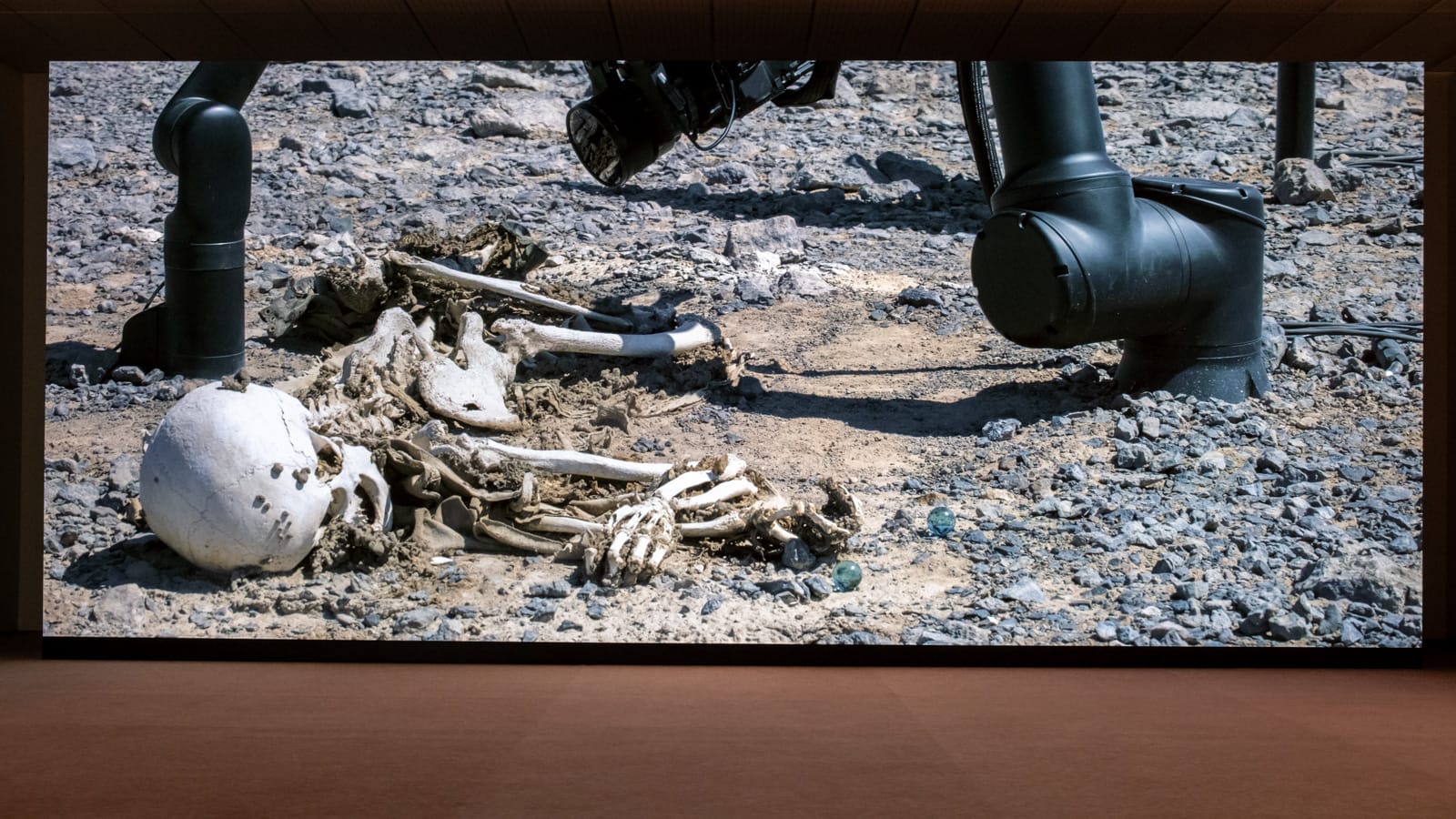
This marked the third time that I saw “Camata” and I was once again mesmerized. It shows robotic arms conducting an inscrutable ritual around a human skeleton in an immense desert. The remains are those of a young man Huyghe found in Chile's Atacama Desert. Sensors in the gallery continuously re-edit the footage, cutting between close-ups of the skeleton, a sinking desert sun and the night sky. The wall-sized film has neither opening nor close, which turns it into a literally timeless meditation on death and impermanence.
The exhibition comes with a catalogue in the form of an artist’s book, which is paradoxically more interesting than the exhibition it accompanies. It includes preparatory sketches, diagrams, photos and source material for some of the works in the show and for some other works by Huyghe, including the amazing “Variants” (2022), created for the Kistefos Museum in Norway.
I was reminded that reversion to the mean is a universal concept that also applies to the arts.
Pierre Huyghe is at the Fondation Beyeler in Basel until 13 September 2026.