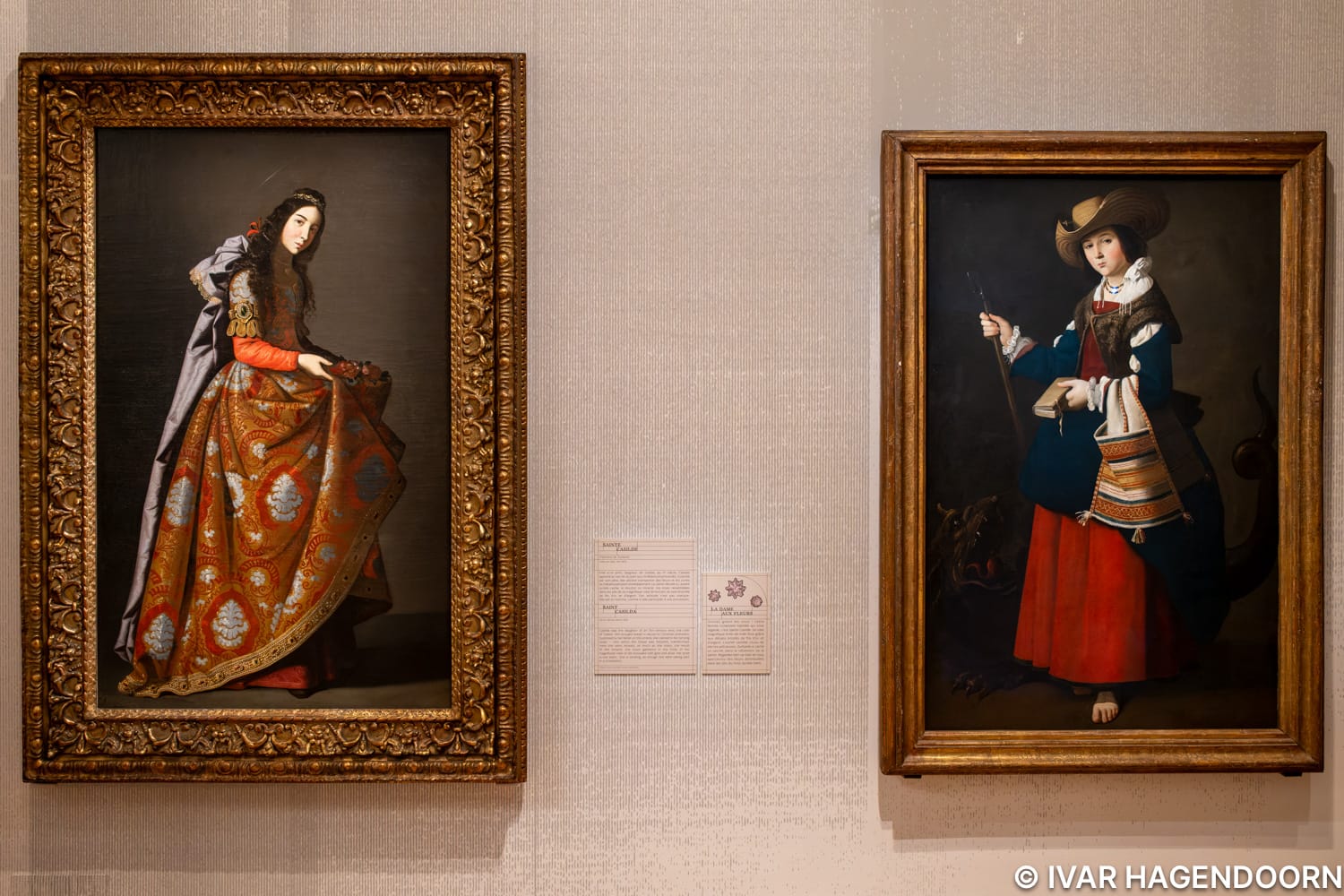
The Zurbarán exhibition at the Louvre is a revelation, at least to me, because it is the first time that I’ve seen such a large selection of his paintings in one show. The exhibition, jointly organized with the National Gallery in London and the Art Institute of Chicago, brings together 65 paintings, of which about fifty by Zurbarán himself.
Francisco de Zurbarán (1598–1664) is the least celebrated among the masters of the Spanish Golden Age. He spent his career painting religious motifs in strict obedience to church doctrine. Zurbarán borrowed his dramatic chiaroscuro from Caravaggio, but the concentrated devotion, the stern realism, and the quiet, stoic interiority of his figures, as in his austere “Saint Francis in Meditation” (1635-39), are entirely his own.
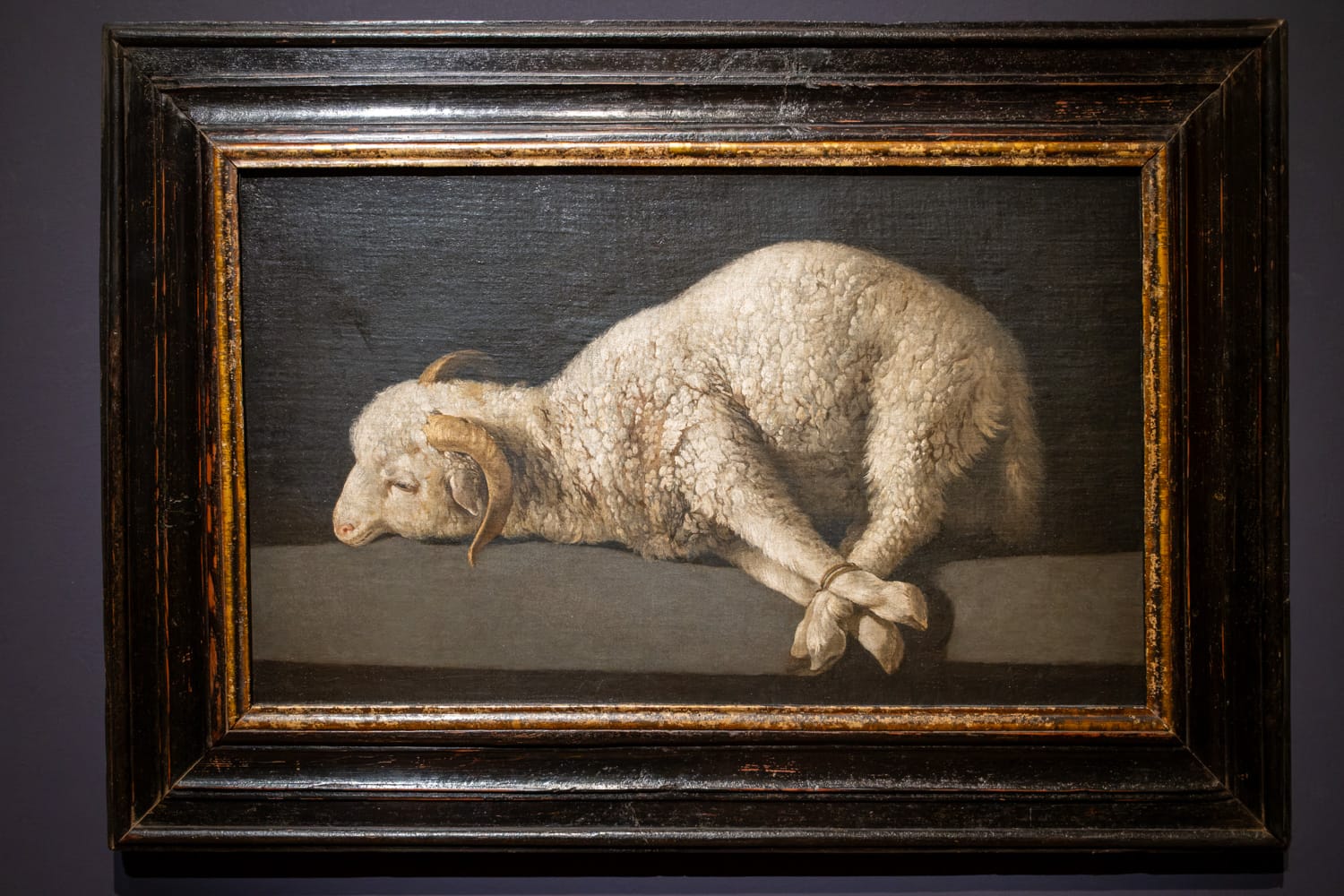
One of Zurbarán best known paintings, “Agnus Dei” (1635–40), shows a bound sacrificial Merino lamb. Rendered with the same meticulous care as the saints’ robes that captivated his wealthy patrons it lies submissive yet visibly alive. The painting dazzles with its subtle gradations of white, which make the pelt seem lifelike.
Zurbarán fortunes, and the quality of his output, tracked the rise and fall of his adopted Seville, so that only about a dozen of the show’s nearly fifty works, mostly from the 1620s and 1630s, reach true brilliance. In those decades the city combined enormous transatlantic wealth with fierce Counter-Reformation piety, and Zurbarán supplied exactly that blend of magnificence and devotion. When he moved to Madrid in 1634 to serve Philip IV alongside Velázquez, he readily traded saints and martyrs for secular themes such as “The Labors of Hercules”. To render Hercules’s size Zurbarán made his body fill the canvas from top to bottom. As Seville’s fortunes waned, however, he turned to colonial markets, churning out devotional series meant to evangelize South America, as well as countless still lifes, which are hardly his finest achievements. Call me biased, but I prefer Dutch 17th century still lifes to Zurbarán’s, which to me look sterile by comparison.
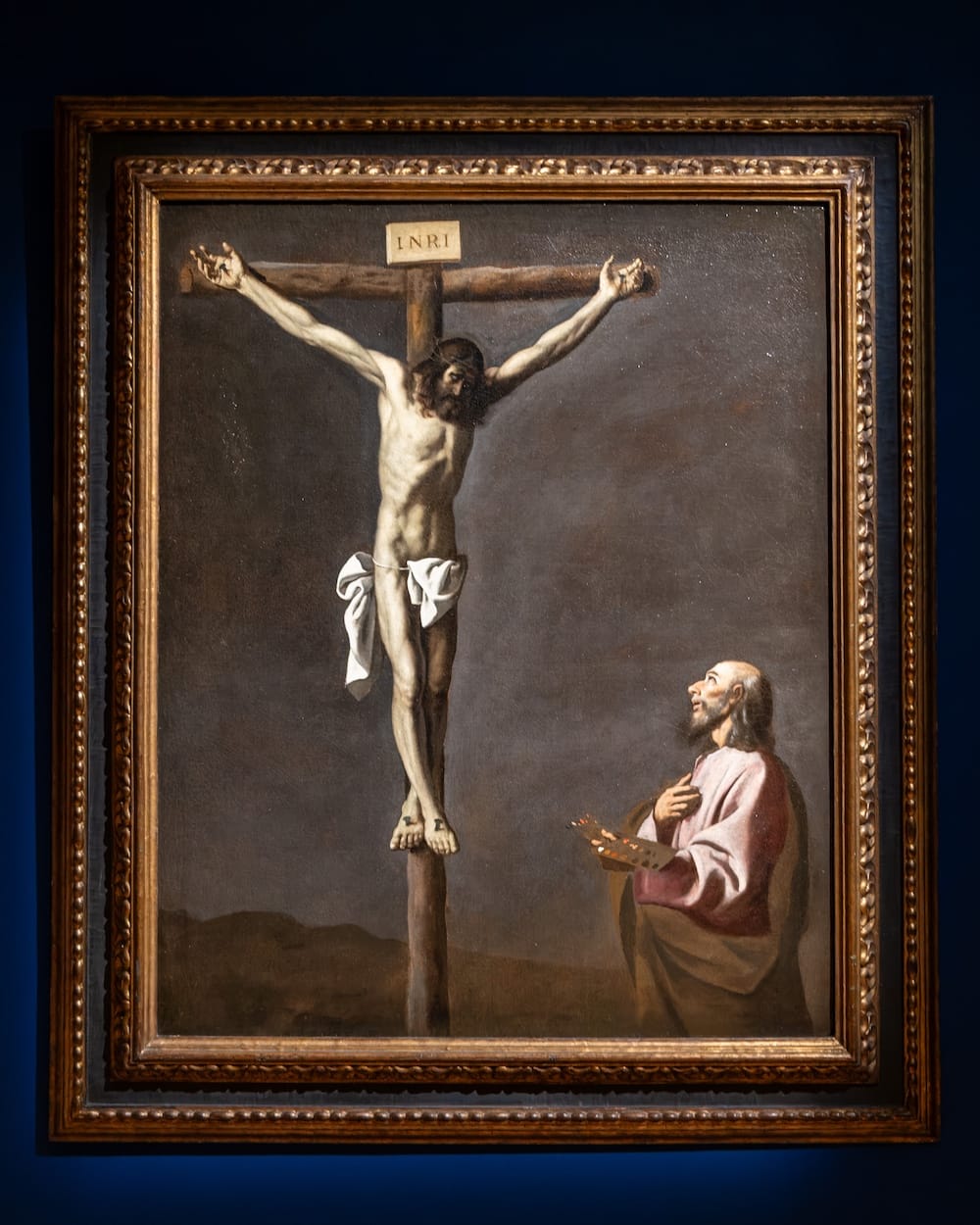
And yet, among his late paintings is also one of the show's most intriguing paintings. “The Crucified Christ With a Painter” (1655-60) shows an elderly painter, a palette in his left hand, who turns his face to that of Jesus. It seems a bit odd that a painter would be present at the crucifixion, ready to put the scene into painting. So what are we looking at? Does Christ appear to the painter in a vision? Or is he contemplating a painting he has just finished? And if that is the case, is the painting perhaps a self-portrait in disguise?
Zurbarán is at the Louvre in Paris until 25 January 2027. It will travel on to the Art Institute of Chicago where it will be on show from 28 February to 20 June 2027.
Related Posts
Rembrandt-Velázquez. Dutch and Spanish Masters at the Rijksmuseum.