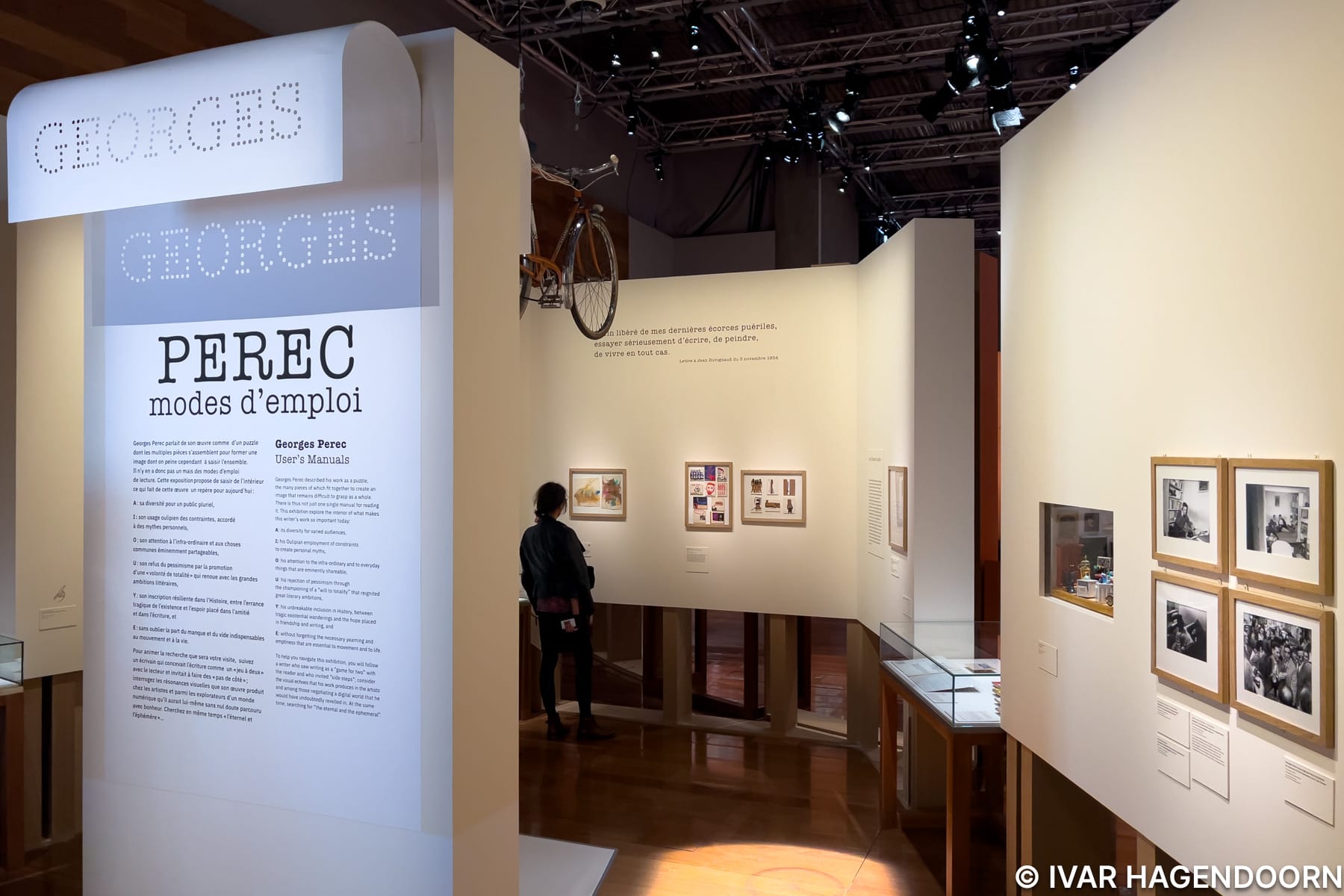
Georges Perec’s Life: A User’s Manual is my favorite novel. To me, it represents the holy grail of artistic creation, combining formal inventiveness with superb storytelling and heartfelt empathy, all within a novel of multiple narrative arcs that culminates in a breathtaking finale that still sends shivers down my spine. What I admire most is that you can read it without noticing any of its formal constraints, and yet the novel would not be the same without them.
I was therefore delighted when I noticed some billboards in the Paris underground for a Georges Perec exhibition at the Bibliothèque National de France. The exhibition marks the ninetieth anniversary of his birth, and it captures the restless ingenuity of a writer who turned play into a creative discipline. Curated by Jean-Luc Joly, who heads the Georges Perec Association, and Claire Lesage of the Bibliothèque National de France, the exhibition unfolds across six rooms, each named for one of the vowels A, E, I, O, U, and Y, a fitting tribute to Perec’s fascination with letters and numbers.
Perec, a longtime CNRS researcher, first gained critical and popular acclaim in 1965 with Les choses. Une histoire des années soixante (Things. A Story of the Sixties). That novel, which won the Prix Renaudot, examined a young couple’s craving for possessions and bourgeois comfort, and it gave its author, who had begun writing when he was still at high-school, a crucial surge of confidence. Sixty years on the novel is still surprisingly fresh and radical. The Ikea scene from Fight Club? That’s Les choses. Perec followed up with a short comic novella, Quel petit vélo à guidon chromé au fond de la cour? (Which Moped with Chrome-plated Handlebars at the Back of the Yard?)(1966), and Un homme qui dort (A man asleep) (1967), which is entirely written in the second person, just like Bright Lights, Big City (1984) by Jay McInerney, and which follows a 25-year-old student who retreats from the world. In 1974, Perec, together with director Bernard Queysanne, adapted the novel for film.
Perec’s literary trajectory took a decisive turn in 1967, when he joined Oulipo. The group’s embrace of formal constraints unleashed his inventiveness, and the exhibition celebrates that spirit through anagrams, lipograms, and puzzles that visitors can tackle on the spot or carry home. In Room O, an AI-powered installation transforms texts into haiku or recasts them in new genres. I also noticed a photo of Georges Perec and Jacques Roubaud, a French mathematician and writer and fellow member of Oulipo, sitting outside in a garden playing Go. I think Perec would have delighted in the opportunities offered by AI. Room E, by contrast, has been left nearly empty except for a fleeting image of the writer’s face, a reference to La disparition (A Void), the novel he composed without the letter “e.”
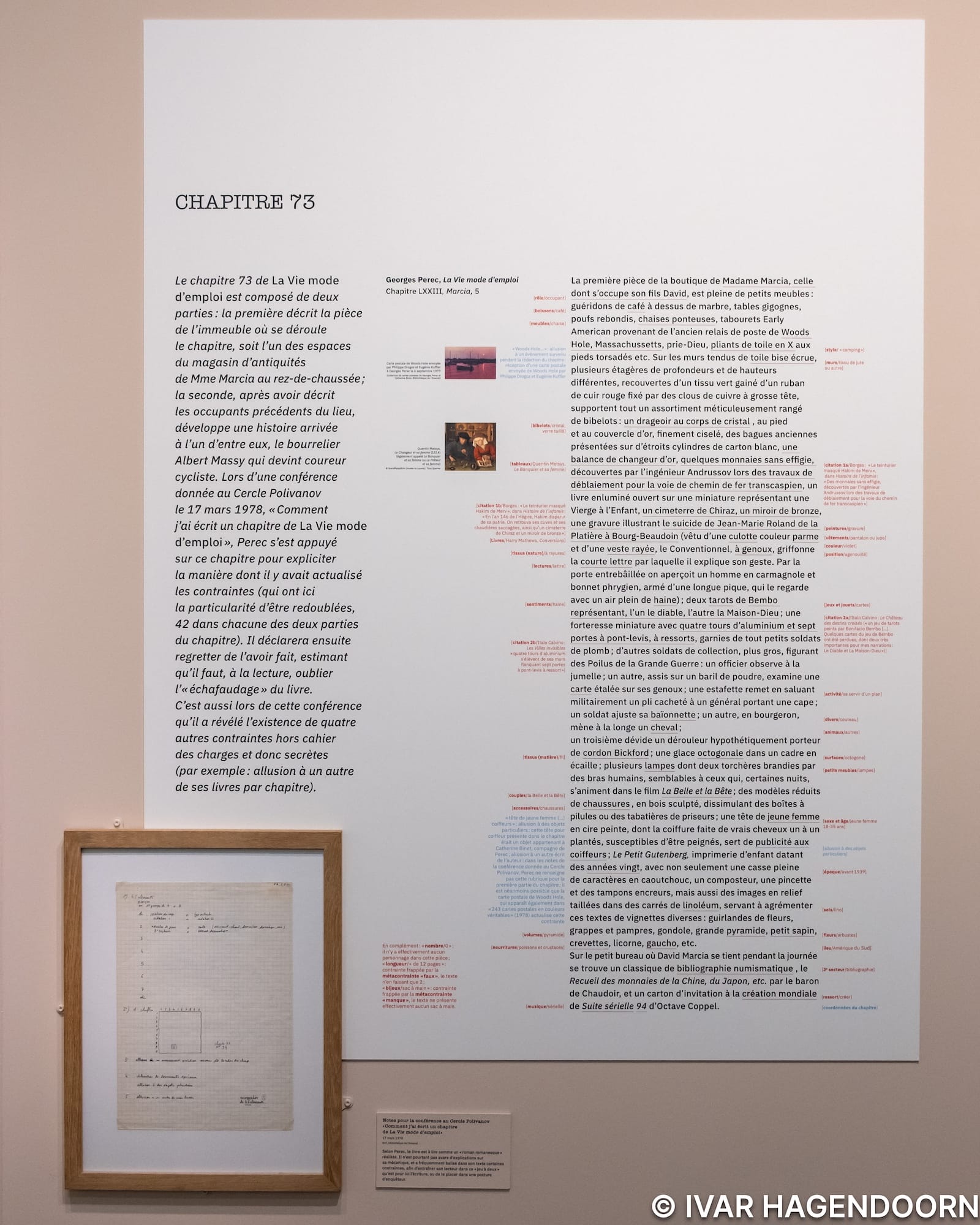
One of the highlights of the exhibition is a room dedicated to Perec’s magnum opus, Life: A User’s Manual (1978). It includes notes, diagrams and early drafts — Perec wrote on graph paper with one character in every cell — and an annotated version of chapter 73, to illustrate how the constraints that Perec set himself in writing the novel come together.
I was surprised to learn that, as a young man, Perec aspired to become a painter. His lifelong admiration for Paul Klee surfaces in two watercolors on display, while a series of roughly sixty whimsical drawings from 1962 reveals his taste for the absurd. I was also delighted to see a selection of Perec’s postcard collection of art reproductions. Like many other artists I, too, have a large collection of postcards sitting on my desk and my book shelves. The opening room, devoted to his youth, gathers notebooks, childhood drawings, and a famous 1959 photograph of him parachuting during military service, a transformative experience he later credited with helping him commit to a career as a writer.
Beneath the playfulness, however, lies profound grief. Perec’s father died in 1940, at the beginning of the Second World War, and his mother, deported, was killed at Auschwitz three years later; W or the Memory of Childhood (1975) is Perec’s attempt to recover the roots and sorrow that history had stolen from him, and the missing “e” of A Void (1969) silently speaks for his vanished parents. This early absence, the exhibition suggests, fueled his ambition to write every conceivable kind of book and set off a lasting tension between loss and exhaustive accumulation. He catalogued ordinary objects and minor events, the “infra-ordinary,” most famously in his account of Place Saint-Sulpice as observed from a café, and he launched the "Places" project in 1969, sealing descriptions of twelve Parisian sites of importance to him in envelopes meant to be reopened years later, though he abandoned it in 1975. Perec bids visitors farewell in Room Y through a silent Super 8 film shot in Tunisia in 1981. He’s laughing and talking, unaware that lung cancer would claim him within months, at just forty-five.
This exhibition is a must for fans of Georges Perec. Needless to say that it helps if you speak French. The exhibition is accompanied by a 400-page catalogue with contributions by numerous scholars as well as some texts by Perec himself.
Georges Perec. Modes d’emploi is at the Bibliothèque National de France in Paris until 14 February 2027. Note: the Bibliothèque National de France is easily reached with Metro 14.
Related Posts
Marcel Proust. La fabrique de l'oeuvre at the Bibliothèque National de France.
Marcel Proust. Un roman Parisien at the Musée Carnavalet.