I was surprised when I read that the Fondation Louis Vuitton would dedicate an exhibition to the collection of Gustave Fayet, because, like many other people, I had never heard of him. But when I saw some images of the works that would be included in the show I immediately added it to my agenda. The exhibition brings together for the first time in a century more than 250 works that were once owned by Gustave Fayet (1865-1925), a French entrepreneur and art collector, and that are now dispersed around the world. Fayet was a shrewd business man and he often sold or swapped works after acquiring them, sometimes within months, and the exhibition also includes works that are thought to have passed through his hands. Upon his death in 1925 his art collection was sold. In the years since some works changed hands multiple times and the organizers of the exhibition have done an admirable job tracking them down.
In 1899, Gustave Fayet inherited a vast estate near Béziers in the South of France. His wife, Madeleine, commanded a fortune nearly equal to his own. That same year he began buying paintings by the dozen, and by 1906 the walls of his Paris house on Rue de Bellechasse were covered floor to ceiling with art, a spectacle rivaling the residences of his Russian counterparts Sergei Shchukin and the Morozov brothers, whose collections were on show at the Fondation Louis Vuitton in 2016/17, respectively 2021/22.
I skipped the crowded opening rooms, with display cases overflowing with letters, catalogues, periodicals and invitations, and moved straight to the galleries offering a sweeping arc through late nineteenth and early twentieth century art, from Manet and Pissarro to Redon, passing through Impressionism, Neo-Impressionism, and the Nabis. Some of Fayet’s purchases seem motivated by a wish for completeness rather than passion. Others betray genuine preference: Degas and Cézanne over Monet and Renoir, Bonnard and Vuillard over Denis. Notably absent are Matisse, Picasso and Braque. Fayet dismissed Cubism outright and he disposed of his Matisses almost as soon as he bought them and it is unclear whether the wonderful “Red Carpets” (1906) was ever part of his collection.
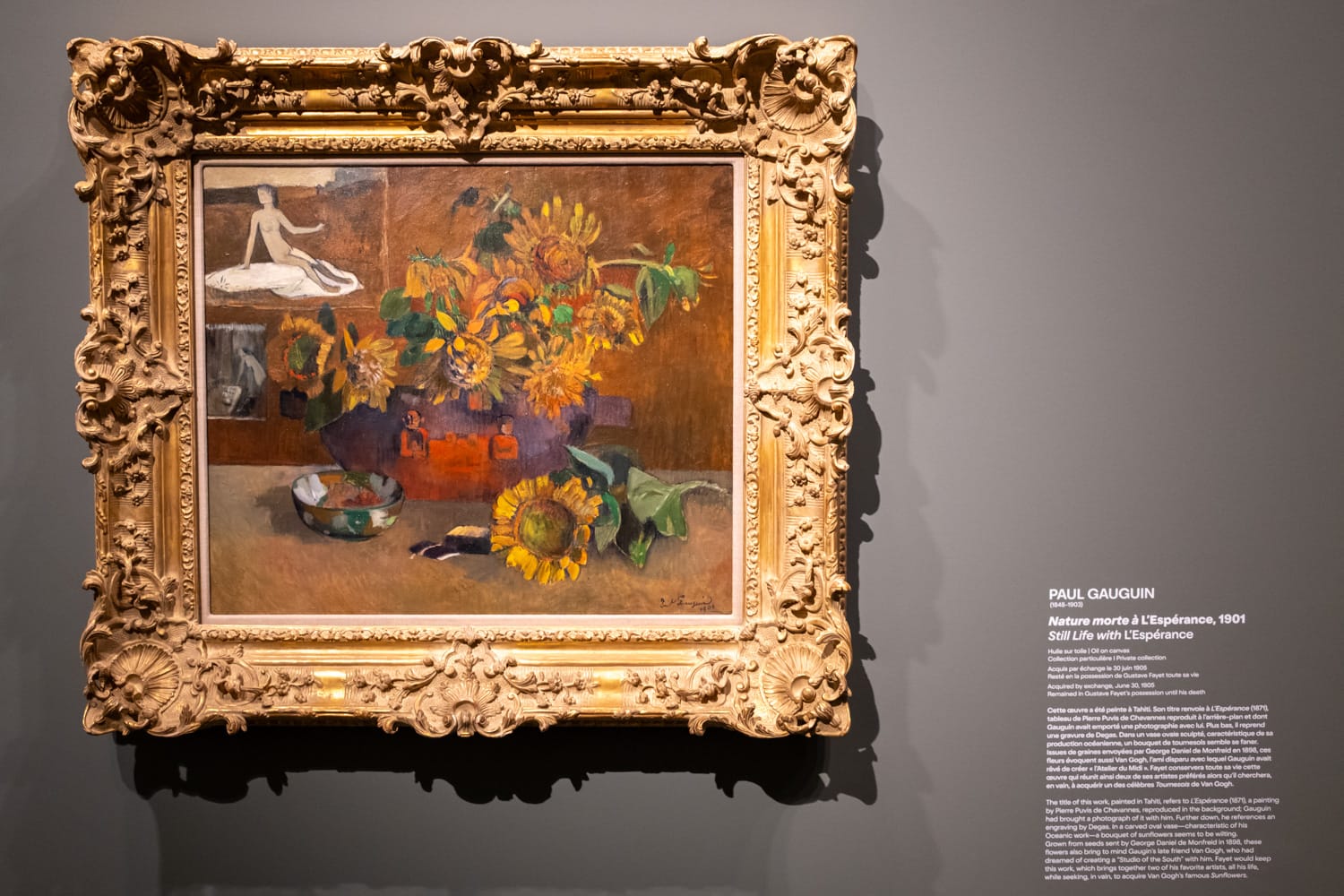
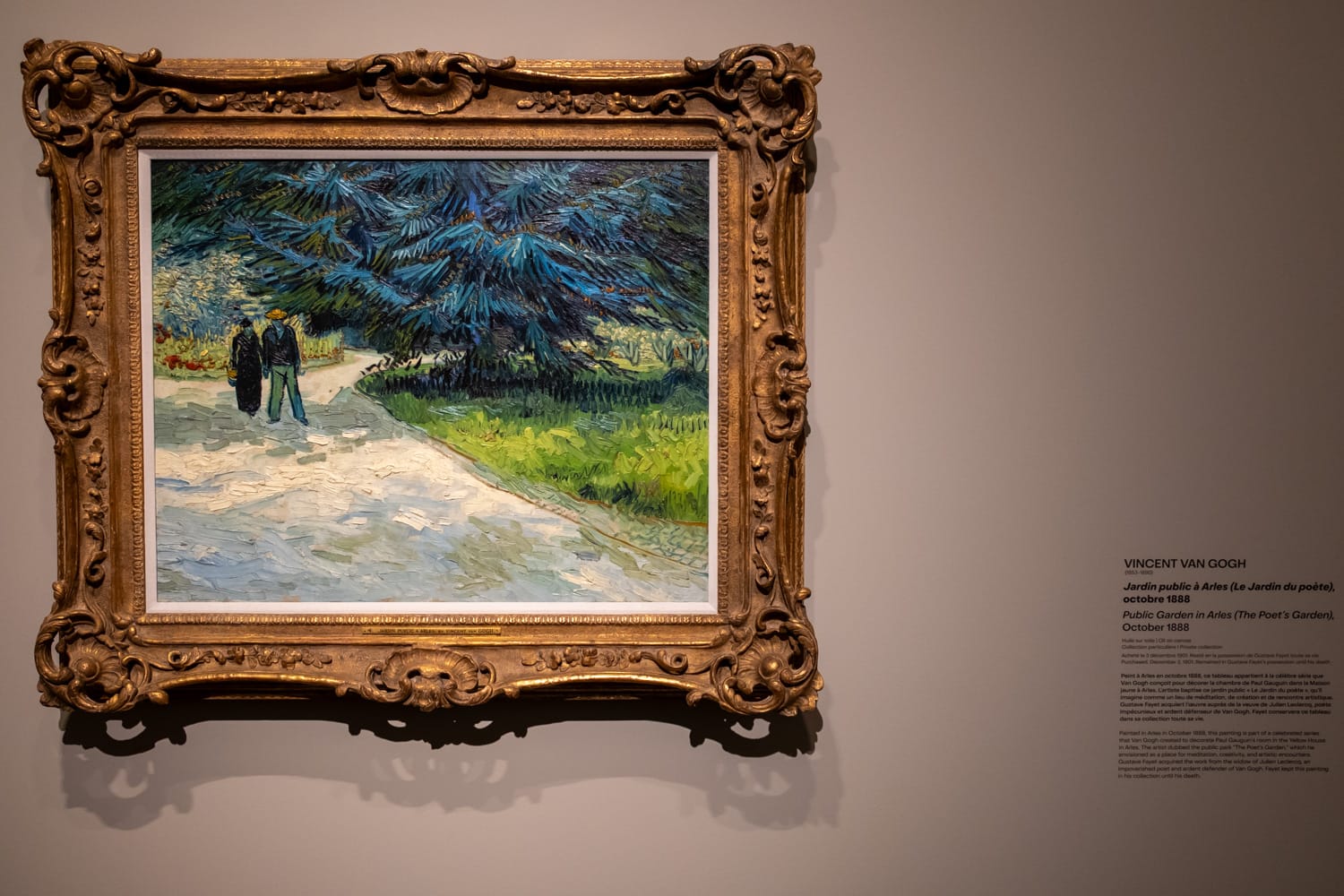
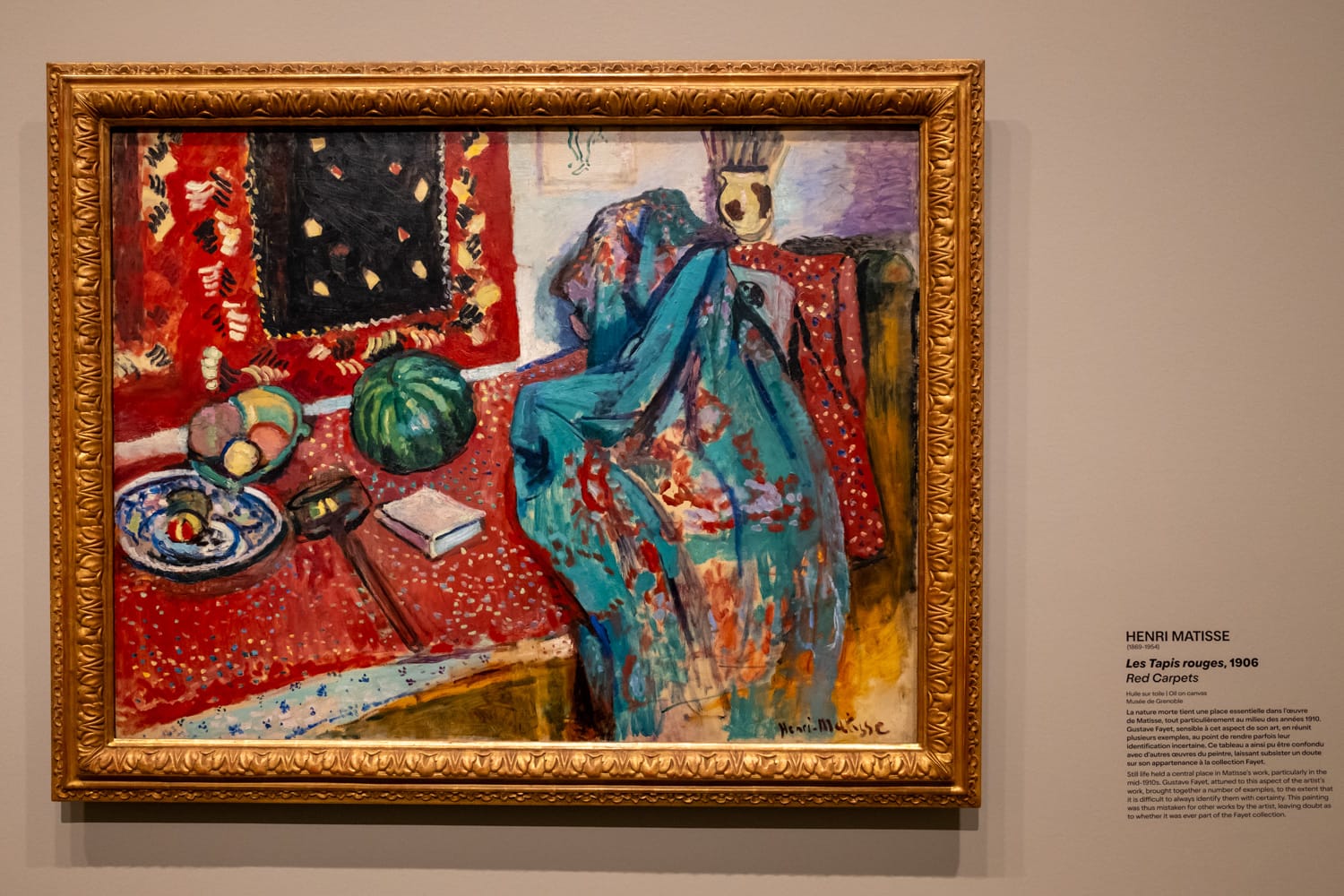
Paul Gauguin "Still Life with l'Espérance" (left), Vincent van Gogh, “Public Garden in Arles” (middle) and Henri Matisse, "Red Carpets" (right)
Highlight of the exhibition is Vincent van Gogh’s stunning “Self-Portrait with Bandaged Ear” (1889), which hasn’t been on public display since 1990. It sold for USD 71.5 million at an auction in 1998 and is now part of the Niarchos collection. It is currently worth double, triple or whatever a billionaire would pay for it, and security is understandably tight. Still, I had ample time to look at it from up close. Its clashing reds, oranges, greens, and blues generate an expressive power that no reproduction can capture. The exhibition includes several more works by Van Gogh that I don’t recall seeing before, including the wonderful “Public Garden in Arles” (1888), also from a private collection, “The Large Plane Trees (Road Menders at Saint-Rémy)” (1889), on loan from the Cleveland Museum of Art and “Harvest in Provence” (1888) from the Israel Museum in Jerusalem.
The exhibition doubles as a Paul Gauguin retrospective, of whom Fayet was an early champion, with some twenty canvases alongside sculptures, ceramics, and prints. I’ve never warmed to Gauguin, largely because I’ve always had some qualms about the Tahiti paintings for which he is famous, but the early landscapes and still lifes included in the show finally won me over.
There is more to enjoy, from “The Manila Cloak” (1910-11) by Kees van Dongen, a “Study for Jan Avril” (1893) by Henri de Toulouse-Lautrec, “The Large Pine” (1887-89) by Paul Cézanne and "Boulevard de Clichy" (1911) by Pierre Bonnard to works by Edgar Degas and Paul Signac.
For the sake of completion the upstairs galleries also include a large selection of watercolors, rugs, illustrations and ceramics by Gustave Fayet himself. These I found largely forgettable, so I quickly descended the stairs to have another look at the works he collected, pausing one more time in front of Van Gogh’s “Self-Portrait with Bandaged Ear” and Matisse’s “Red Carpets”.
Gustave Fayet: Collector - Designer. Icons of Modern Art is at the Fondation Louis Vuitton in Paris until 8 March 2027.
Related Posts
Icons of Modern Art: The Shchukin Collection at the Fondation Louis Vuitton.
Icons of Modern Art: The Morozov Collection at the Fondation Louis Vuitton.